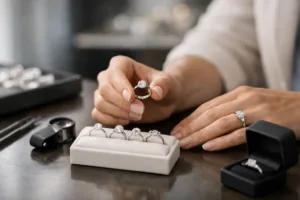
How to Choose Diamond Rings With Confidence
Choose diamond rings with confidence. Compare natural and lab-grown diamonds, cuts, settings, certification and metals for a ring made to last for years.
We Buy Gold . Top Prices Paid .
7 Day Price Promise .
30 Day Returns
Free World Wide Shipping
Life Time Warranty
We Buy Gold . Top Prices Paid .
7 Day Price Promise .
30 Day Returns
Free World Wide Shipping
Life Time Warranty

+44 203 965 6669
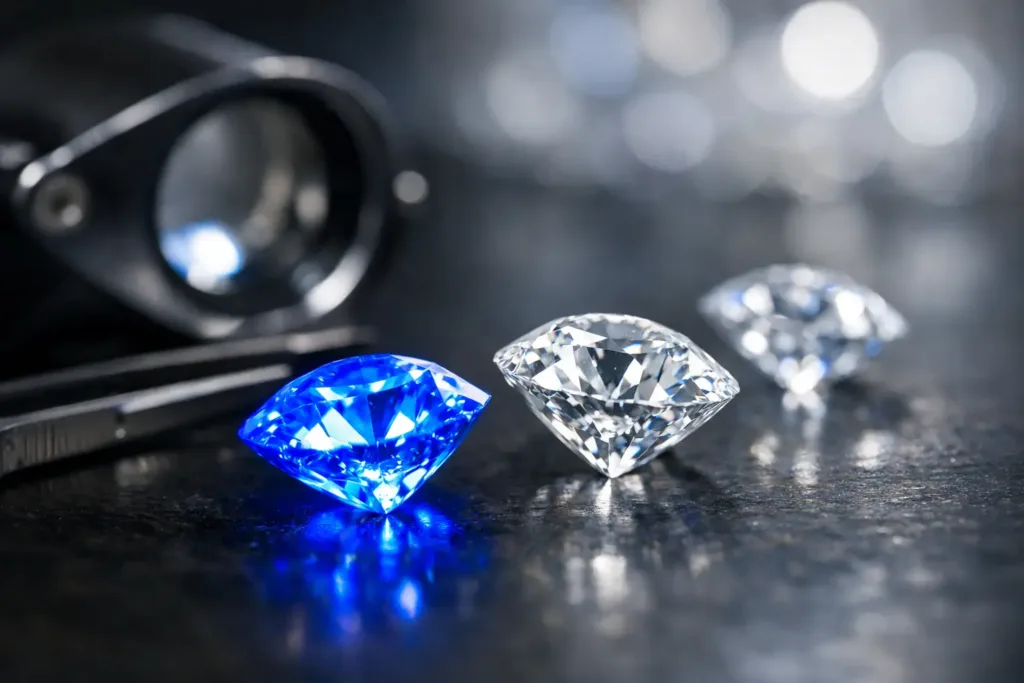
A diamond can look bright and beautiful in the showroom, then slightly different under daylight or UV-heavy lighting. That shift often comes down to fluorescence – a grading feature many buyers notice on a certificate but do not always fully understand. This guide to diamond fluorescence explains what it means, when it matters, and how to judge it with confidence when choosing a certified diamond.
Diamond fluorescence is the visible glow some diamonds emit when exposed to ultraviolet light. In most cases, that glow appears blue, although other colours can occur more rarely. The effect stops once the UV source is removed, so it is not a permanent visual feature in ordinary indoor conditions.
On a grading report, fluorescence is usually described by strength rather than by long technical notes. You will commonly see None, Faint, Medium, Strong or Very Strong. For many buyers, that single line on the certificate raises more questions than answers, especially when comparing two otherwise similar stones.
The key point is simple. Fluorescence is not automatically good or bad. It is one characteristic among many, and its effect depends on the individual diamond.
Fluorescence grading tells you how noticeable the reaction is under UV light, not whether the diamond will always look different to the eye. A diamond graded None has no observable fluorescence. Faint is usually minimal. Medium may be noticeable in some lighting, while Strong and Very Strong are more likely to have a visible effect in certain conditions.
That does not mean a Strong fluorescent diamond will look poor. In fact, many do not show any negative impact at all in everyday wear. The issue is that stronger fluorescence increases the chance of a hazy, oily or slightly milky appearance in a small number of stones. This is why visual assessment matters as much as the grading line itself.
For buyers focused on confidence and long-term value, this is where certification and honest guidance become important. A report gives you the technical starting point, but the actual stone tells the full story.
Most of the time, fluorescence has little to no effect in normal indoor environments. Under bright sunlight or places with stronger UV exposure, a fluorescent diamond may show a soft blue glow. In lower colour grades, that blue reaction can sometimes make the diamond appear a touch whiter.
This is one reason fluorescence has a more nuanced reputation than many shoppers expect. In near-colourless diamonds, particularly around the H to J range, a little fluorescence can be helpful. It may improve the face-up appearance in daylight and offer attractive value compared with a similar non-fluorescent stone.
At the higher end of the colour scale, such as D to F, buyers often prefer None or Faint fluorescence. These colourless diamonds are purchased for crisp, icy transparency, and stronger fluorescence can be viewed more critically in the trade. Even then, the real question is not the label alone, but whether the stone remains bright and clear.
Sometimes, but not often.
This is one of the biggest concerns buyers have, and rightly so. Strong or Very Strong fluorescence can, in a minority of diamonds, create a soft haziness that reduces transparency. When that happens, the diamond may look less sharp or lively, especially in natural light.
However, many fluorescent diamonds do not look cloudy at all. Some appear completely normal, while others benefit from a slightly whiter visual impression. That is why broad rules can be misleading. Two diamonds with the same fluorescence grade can perform very differently.
A trustworthy buying process should never rely on the certificate alone for this point. You want to know how the stone actually presents, not just how it reacts under laboratory conditions.
Fluorescence can affect price, but the direction depends on the diamond.
In higher colour grades, especially D to F, Medium to Strong fluorescence may lower the price compared with a similar diamond with no fluorescence. This is largely driven by market preference. Buyers paying a premium for top colour often want the cleanest possible grading profile.
In slightly lower colour grades, fluorescence can represent strong value. If an H, I or J colour diamond faces up beautifully and the fluorescence improves its apparent whiteness, you may secure a more attractive price without sacrificing visual appeal. For practical buyers, that can be a smart balance of beauty and budget.
Lab-grown diamonds and natural diamonds can both show fluorescence, although the market may respond differently depending on the stone and the grading details. Either way, the same principle applies – appearance first, certificate second.
There are situations where fluorescence is worth considering positively rather than treating it as a fault.
If you are shopping for a near-colourless diamond and want maximum visual value, Faint to Medium blue fluorescence can be appealing. It may help the stone appear brighter in daylight, while also keeping the price more competitive than a non-fluorescent equivalent.
This can be particularly useful when balancing several priorities at once, such as carat weight, cut quality and overall budget. Many engagement ring buyers would rather secure a beautifully cut diamond with slight fluorescence than overpay for a technically cleaner profile with less visible impact.
That said, the benefit only applies when the diamond remains lively and transparent. If fluorescence introduces any dullness, the saving is rarely worth it.
Caution makes sense with Strong or Very Strong fluorescence in high colour diamonds, or in any diamond that appears milky in person or on close inspection. This does not mean ruling such stones out automatically. It means checking them more carefully.
You should also be more selective if you are purchasing primarily for rarity, prestige grading or future resale positioning. Buyers in the top end of the market often favour D to F colour with minimal fluorescence because those combinations tend to align better with mainstream demand.
For a bespoke ring or a piece intended for regular wear, the decision can be more flexible. A visually beautiful diamond with fluorescence may still be the right purchase if it meets your priorities on brilliance, budget and certification.
The most sensible way to assess fluorescence is to place it in context with the rest of the diamond. Cut quality remains the biggest driver of beauty. A well-cut diamond with some fluorescence will usually outperform a poorly cut diamond with none.
Start with the grading report, but do not stop there. Look at the diamond in different lighting where possible. Ask whether the stone shows any milkiness or loss of transparency. Consider its colour grade as part of the decision. Then weigh the price difference against what you can actually see.
This is especially important when buying online or from a distance. Clear certification, accurate presentation and expert support matter far more than blanket claims about fluorescence being either desirable or undesirable.
One common myth is that fluorescence means the diamond is fake. It does not. Both natural and lab-grown diamonds can fluoresce, and many genuine diamonds show this feature.
Another misconception is that any fluorescence lowers quality. Again, that is too simplistic. In some diamonds it has no visible effect. In others, it can even improve apparent whiteness. The issue is not fluorescence itself, but whether it helps, harms or makes no difference to the individual stone.
There is also a tendency to overvalue certificate purity over real-world appearance. Buyers can become so focused on avoiding one technical feature that they miss an excellent diamond offering stronger beauty and better value overall.
For many buyers, yes – if the diamond looks exceptional.
If you are choosing an engagement ring, anniversary gift or timeless everyday piece, fluorescence should be judged practically rather than emotionally. A certified diamond with Faint or Medium fluorescence can be an excellent purchase, particularly in near-colourless grades. Stronger fluorescence is not off-limits either, but it should be assessed with more care.
At Hispek Diamonds, the right diamond is never chosen by one grading line alone. It is chosen by the balance of beauty, certification, value and confidence. Fluorescence is part of that picture, not the whole story.
The best approach is to treat fluorescence as a detail worth understanding, not a feature to fear. When a diamond is properly graded, honestly presented and visually impressive, that small line on the certificate becomes much easier to place in perspective.
Choose diamond rings with confidence. Compare natural and lab-grown diamonds, cuts, settings, certification and metals for a ring made to last for years.
Choose silver chains for men with confidence: compare sterling silver styles, lengths, widths and care for polished everyday or occasion wear with ease.
Modern Asian bridal jewellery trends unite heritage goldwork, diamonds and personal styling. Learn how to choose certified pieces with lasting value today.
Understand natural diamond investment value, from rarity and certification to resale realities, so you can buy a timeless stone with greater confidence.
Find the best Asian gold bangles for everyday wear, weddings and gifts. Compare 22K purity, designs, fit, hallmarking and lasting value with confidence.
Our diamond tennis necklace guide explains carat weight, diamond quality, length and setting, helping you choose a certified necklace with confidence.