

Best 22k Wedding Bangles for a Bridal Look
Choose the best 22k wedding bangles for your bridal look, with expert guidance on purity, fit, weight, hallmarking, style and lasting value for life.


Every diamond ring comes down to two parts: the centre stone and the mount that holds it. Most buyers can describe the stone they want. Fewer can describe the mount, even though it decides how the stone sits, how much metal shows and which details frame it.
Knowing the language of both makes diamond ring selection far easier, whether you pick from a ready made design or have a ring custom built with the diamond and ring mount of your choice. Here’s a practical guide to what you’re looking at.
A ring mount does more than hold the diamond in place. Its head, shank, shoulders and finishing details all contribute to the design, while the centre stone brings its own characteristics of cut, clarity and colour.
The head is the part that grips the centre stone. On our featured solitaire, a minimalist and classic engagement ring, that’s a raised six claw mount head, which lifts a single stone into view.
The shank is the band itself, and it doesn’t have to be a single line. Our halo designs include a split shank, with round diamonds set along it.
The shoulders are where the shank meets the head, and they’re often where extra diamonds go. In a side stone ring, smaller diamonds run down the shoulders either side of the larger centre stone, set within a channel or held in claws. In our trilogy design, three smaller stones sit on either side, in line with the ring shoulders.
Then there are finishing details. Vintage designs use the classic milgrain effect, combined with different metals, diamond shapes, sizes and colours, for a more traditional look.
The metal is the other half of the mount decision. Our featured solitaire can be made in any colour of 18K gold or in platinum. Our halo and trilogy designs are available in any combination of 18K metal colour, and our designer rings mix colours outright, such as a leaf shaped mount formed from white and yellow gold.
Whichever metal you choose, our precious metal products are hallmarked in line with UK requirements.
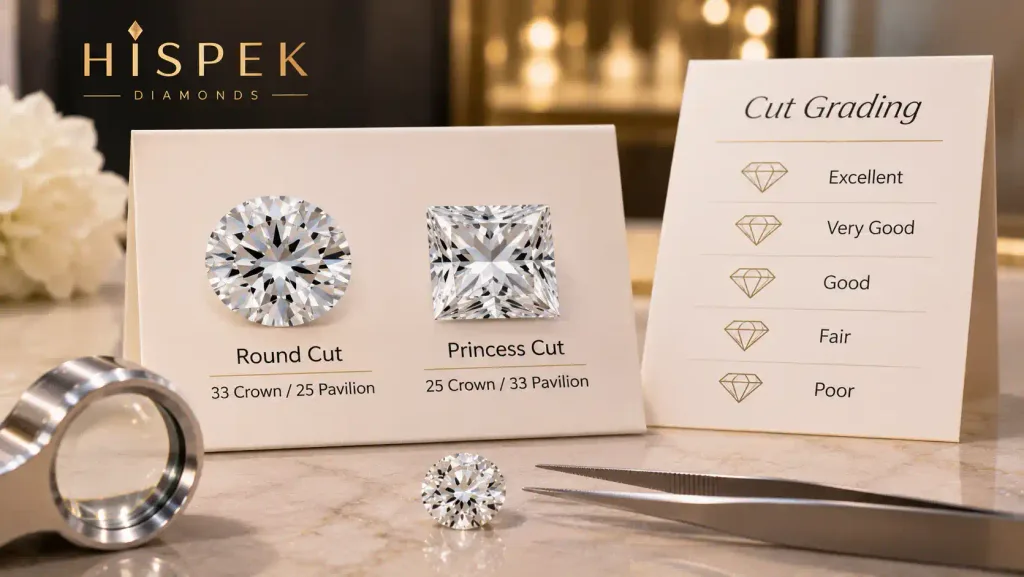
Turning a rough diamond into a finished stone is an artistic process. The rough largely determines the proportions and facets, but the cut still shapes the result. Cut grading runs from Excellent to Poor and considers brightness, fire, scintillation, weight ratio, durability, polish and symmetry. While the colour and clarity of most diamonds are set by nature, cut and shape are where expert cutters make a diamond unique.
Proportion is about the relationship between the width of the table, the flat top surface, and the depth of the stone. Facet layout differs by shape too. A round diamond has 33 facets on the crown, or top portion, and 25 on the pavilion below. A princess cut, also known as a square modified cut, reverses that balance, with 25 on the crown and girdle and 33 on the pavilion.
Clarity grades depend on the number and placement of internal inclusions and surface blemishes visible under 10x magnification. The most common inclusions are feathers, pin points and crystals.
Internally Flawless diamonds are amongst the rarest and most sought after, sitting one grade below Flawless. Further down the scale, VVS2 diamonds have inclusions that can’t be seen with the naked eye and need 10x magnification to find, which makes them another option for buyers seeking high clarity.
Colour is easiest to understand when you see it set. D, E and F are the highest colourless grades. Within J to N, a yellow tinge becomes more obvious when you compare the stone with higher grades.
Our diamond colour guide shows stones in real mounts, from an E colour on a solitaire mount and D and F colours on shoulder mounts to a K colour on a rose gold mount and a fancy yellow on a halo mount. Comparing those examples can help you understand how diamond colour appears with different mounts, although photographs may not show every colour difference exactly as you’d see it in person.
Once you understand the difference between the head and shank, and between IF and VVS2 clarity grades, you have a clearer starting point for comparing rings. You can ask for exactly the mount details you like, and judge a centre stone on what’s really graded. That’s the point of understanding diamond ring selection: you end up with a centre stone and ring mount chosen for each other.
Need help? Book An Appointment for our Full Customised Engagement Ring Service, or start online with Create Your Own, beginning with either the setting or the diamond. You can also call us on +44 203 965 6669.
Which metals can a ring mount be made in?
It depends on the design. Our featured solitaire can be made in any colour of 18K gold or platinum, while our halo and trilogy designs come in any combination of 18K metal colour.
How are smaller diamonds held on the shoulders of a ring?
In our side stone rings, the smaller diamonds are either set within a channel or held in claws.
What is the difference between IF and VVS2 clarity?
Internally Flawless diamonds are one grade below Flawless and are amongst the rarest. VVS2 diamonds have inclusions that can’t be seen with the naked eye and need 10x magnification to find.
What does cut grading actually look at?
Cut grades run from Excellent to Poor and consider brightness, fire, scintillation, weight ratio, durability, polish and symmetry.