

8 Platinum Jewellery Benefits Worth Knowing
Discover platinum jewellery benefits, including enduring strength, natural white colour, skin-friendly purity, rarity and considered long-term value.

Most people who start looking for a diamond ring already have something in mind. It might be a shape, perhaps an oval or a cushion. It might be a feeling about the ring as a whole, clean and simple or bright with smaller diamonds. The harder part is turning that picture into two choices that have to work together: the stone, and the setting that holds it.
Choosing one without considering the other can make it harder to achieve the ring you imagined. That’s where expert diamond ring advice earns its place. Our jewellery consultants have many years of experience selling luxury products to clients with all kinds of requirements, and our role is to support you in finding the right diamond, then the mount that suits it.
Finding the right balance between a diamond and its setting starts with understanding how shape, cut, clarity and colour influence your choices. Each of those details bears on the setting you choose, and the setting in turn narrows down which stones make sense.
When you create your own ring with us, there are two ways in. You can start with a ring setting, choosing from hundreds of styles in a range of metals and centre diamond shapes. Or you can start with the diamond, searching thousands of certified natural diamonds from our live stock database, across a range of colourless grades, shapes and sizes to suit your taste and budget.
Neither route is right for everybody. If you already know you love a halo or a trilogy, the setting will narrow down which stones make sense. If a particular diamond matters more to you than the mount, beginning there keeps your attention where it belongs. Either way, talking it through first stops you falling for a stone that the style you want doesn’t suit.
Shape and setting are more closely linked than many buyers expect. A solitaire, the classic single stone design, can be custom made in a variety of shapes, but it’s best suited to a round, cushion or princess cut diamond. A halo, where a large centre stone is surrounded with smaller diamonds, works best with round, oval and cushion shaped centre stones.
Trilogy rings, also known as three stone rings, are more flexible. They can be made in a variety of diamond shapes and sizes, and even with a combination of different shape cuts.
It also helps to know what each shape does with light. Round, princess, oval and marquise diamonds each have 58 facets, though the layout differs by shape. An oval has two identical head ends, symmetrical shoulders and a central belly, so its light properties are very similar to a round. A cushion cut diamond has softly rounded corners and a pillow like shape. It’s known for producing more fire and scintillation than a round, depending on its clarity grade and cut grade, so it’s worth comparing the two before you choose. And a marquise’s long elliptical shape makes the stone look larger.
Carat measures weight, not size. One carat equals 0.2 grams, and although size goes up with carat weight, the two aren’t perfectly matched. A 1.0ct diamond is not five times larger than a 0.2ct diamond.
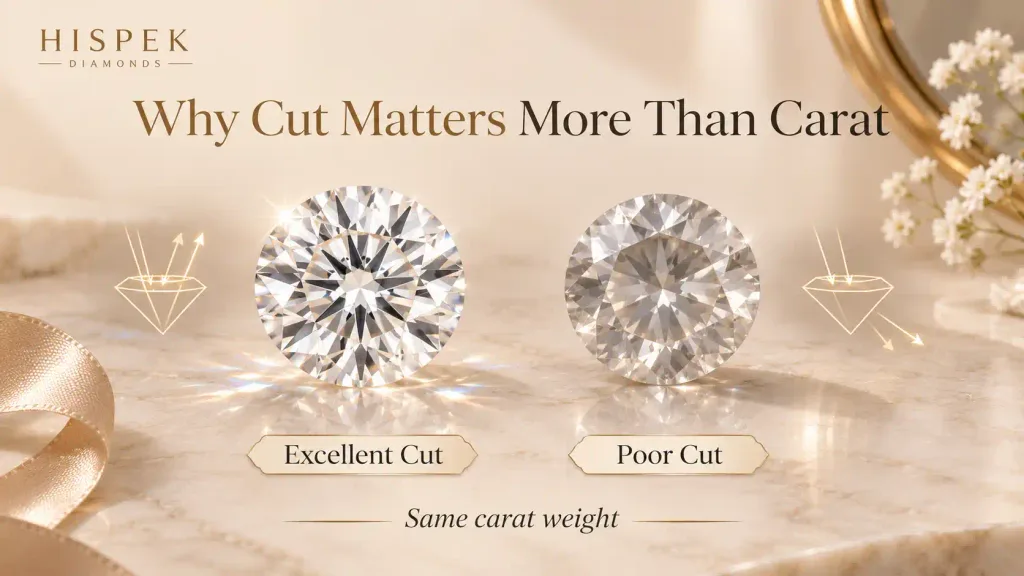
What really changes how big a stone looks is the cut. A well cut diamond will seem larger than a poorly cut one of the same carat weight, because of the way it reflects light. Cut quality is commonly graded from Excellent through Very Good, Good and Fair to Poor, helping buyers compare how well diamonds are proportioned and finished. Cut a diamond too deep or too shallow and light leaks out rather than reflecting back through the top. Even a stone with very good colour and clarity loses its sparkle when that happens.
That’s why cut is arguably the most important of the 4Cs. For a feel of how shapes compare, our Diamond Size Comparisons show typical sizes of Excellent cut diamonds across shapes. Actual sizes still vary within the same weight band depending on cut grade.
Clarity is graded on the number and size of naturally occurring inclusions. There are eleven recognised clarity grades, from Flawless down to I3, and most inclusions can’t be seen with the naked eye, particularly in a VS1 diamond or higher.
This is where stone and setting decisions genuinely meet. For a solitaire above half a carat, we recommend considering VS2 as a starting point for clarity and value. Cut quality also matters when assessing the diamond’s brightness and scintillation. SI2 diamonds usually have slight inclusions and are generally used where smaller stones, under a quarter of a carat, are needed. So the guidance for a centre stone isn’t the same as the guidance for the smaller diamonds set around it.
The distinction becomes clearer when you look at a design with several diamonds. Our L01513 Halo Design Ring has 80 round diamonds set along a split shank and around a 1.5ct centre stone. We can customise it in different 18K gold colours with a centre diamond of your choice, allowing you to consider the larger stone and surrounding diamonds separately. If you prefer a three stone design, our featured trilogy ring combines a 1ct round centre diamond with two 0.5ct round VS quality diamonds. Three smaller stones on each shoulder complete the arrangement, giving you another way to balance the centre stone with its surrounding diamonds.
Colour is graded from D, which is colourless, to Z, light yellow or brown. For white diamonds, less colour is better, and the lower the grade the more noticeable the yellow tinge.
The metal around the stone plays its part too. Platinum or white gold can enhance a diamond’s appearance, which is a good reason to weigh colour and metal together. Our featured solitaire, a minimalist design with a raised six claw mount head, can be made in any colour of 18K gold or in pure platinum. If you’re drawn to warmer tones, the grades from N to R, where the yellow is very obvious, can produce some remarkable designs when combined with colourless stones.
A certificate gives you documented grading to check against what you’ve been told about a stone. For independent certification of our diamonds, we only use highly reputable laboratories such as the Gemological Institute of America (GIA), the International Gemological Institute (IGI) and the European Gemological Institute. Our diamond search lets you filter by shape, carat, clarity, cut, polish, symmetry and certificate or lab, so you can narrow the field before you speak to us.
Every diamond we sell is conflict free as defined by the Kimberley Process. Each Hispek diamond ring comes with a lifetime warranty and a price promise, backed by a consistent pricing policy all year round. Our precious metal products are hallmarked in line with UK requirements, and Nascoglobal Limited, trading as Hispek Diamonds, is a member of the National Association of Jewellers and is registered with the Birmingham Assay Office.
A ring that works is one where the diamond and the setting were chosen with each other in mind: a shape the style suits, a cut that makes the most of the carat, clarity judged for the stone’s role, and a colour that sits well against the metal. That’s what expert diamond ring advice should give you. You don’t need it all worked out before you get in touch. Bring the shape you keep coming back to, or the style you’ve saved, and we’ll help you build from there.
We’re based in London at Matrix Business Centre, 167-169 Station Road, Edgware, HA8 7JU, and in Leicester at The Old School House, 65A London Road, Leicester, LE2 5DN. Our hours are Monday to Saturday, 09:00 to 18:00, and Sunday, 10:00 to 16:00, UK time.
Need help? Book An Appointment for our Full Customised Engagement Ring Service, or start online with Create Your Own and Search Diamonds & Prices. You can also call us on +44 203 965 6669 or email contact@hispekdiamonds.com.
Should I choose my diamond or my ring setting first?
Either works. With Create Your Own, you can start with a ring setting from hundreds of styles in a range of metals and centre diamond shapes, or start with a diamond from thousands of certified natural diamonds in our live stock database. If you’re unsure which suits you, book an appointment and we’ll talk through both.
Which diamond shapes work best in a halo engagement ring?
A halo, where a large centre stone is surrounded with smaller diamonds, is best suited to round, oval and cushion shaped centre diamonds. If you’re leaning towards a solitaire instead, round, cushion and princess cuts are the best fit.
What clarity grade should I look at for a solitaire over half a carat?
We recommend considering VS2 as a starting point for clarity and value when choosing a solitaire above half a carat. Cut quality is also important when assessing brightness and scintillation.
Which laboratories certify your diamonds?
We only use highly reputable diamond laboratories for independent certification, such as GIA, IGI and the European Gemological Institute. You’ll find the certificate or lab listed as a filter in our diamond search.