

Modern Asian Bridal Jewellery Trends for 2026
Modern Asian bridal jewellery trends unite heritage goldwork, diamonds and personal styling. Learn how to choose certified pieces with lasting value today.


To match a 22K gold pendant with the right chain, Hispek Diamonds looks beyond colour and style. The bail must accept the chain and its end fittings, the chain length must place the pendant where you want it, and the chain must feel appropriately balanced with the pendant’s weight and movement. When these three points work together, the pendant hangs cleanly, and the pairing feels intentional.
Our 22K gold pendants include different silhouettes and proportions, while our 22K gold chains include varied link patterns. We recommend checking the exact product details for both pieces, because a visual match does not automatically guarantee a physical fit.
The bail is the loop or fitting that connects a pendant to a chain. Its internal opening controls what can pass through it. A chain may look slim enough through most of its length but still fail to pass through because the clasp, end cap, or end tag is wider than the links.
We therefore suggest checking the narrowest usable part of the bail and the widest component that must travel through it. A decorative, fixed or unusually shaped bail may also limit the angle at which a chain can move. If the pendant is designed with an integral chain or a non-opening connection, changing the chain may require professional attention.
A compatible bail needs more than bare clearance. The chain should move through the opening without scraping, wedging, or forcing the pendant to sit at an angle. Too little space can restrict movement and place repeated pressure on the same contact points. Excessive space can let a small pendant swing unpredictably or turn more often.

Look at the bail from the front and side. A narrow front view may conceal useful depth, while a wide decorative front may conceal a small internal channel. We avoid estimating compatibility from a single photograph. If exact bail measurements are not shown, contact us to ask about a particular pairing.
A delicate pendant often looks harmonious on a fine chain, while a broad or substantial pendant usually needs a chain with enough visual presence to support the composition. Physical balance matters as well. A pendant should not pull a very fine chain into a sharp V, overwhelm the clasp, or make the chain feel fragile during normal movement.
At Hispek Diamonds, we do not rely on one universal pendant-to-chain weight ratio because link construction, wire thickness, soldered joins, chain condition, and bail design all affect suitability. Instead, we assess the complete pairing. A compact rope-style chain and a flat chain of similar weight can respond differently to the same pendant because each structure bends and distributes force differently.
Chain length decides where the pendant sits on your chest and how it interacts with a neckline. A shorter chain brings the pendant closer to the base of the neck. A medium length often places it across the upper chest. A longer chain gives the pendant more room to move and can create a stronger vertical line.
Your neck size, clothing, and the pendant’s own height all affect the final drop. Measure a chain you already enjoy wearing, including the clasped length, and note where its centre sits. Then add the pendant height below the bail to estimate the full visual drop. This approach is more reliable than choosing a length from a generic label alone.
Style can reinforce the pendant or create a deliberate contrast. A simple chain keeps attention on an ornate motif. A textured chain can complement a bold pendant, provided the bail permits smooth movement. We also check whether the link pattern tends to twist, whether the pendant can settle at the centre, and whether the chain has a defined front face.
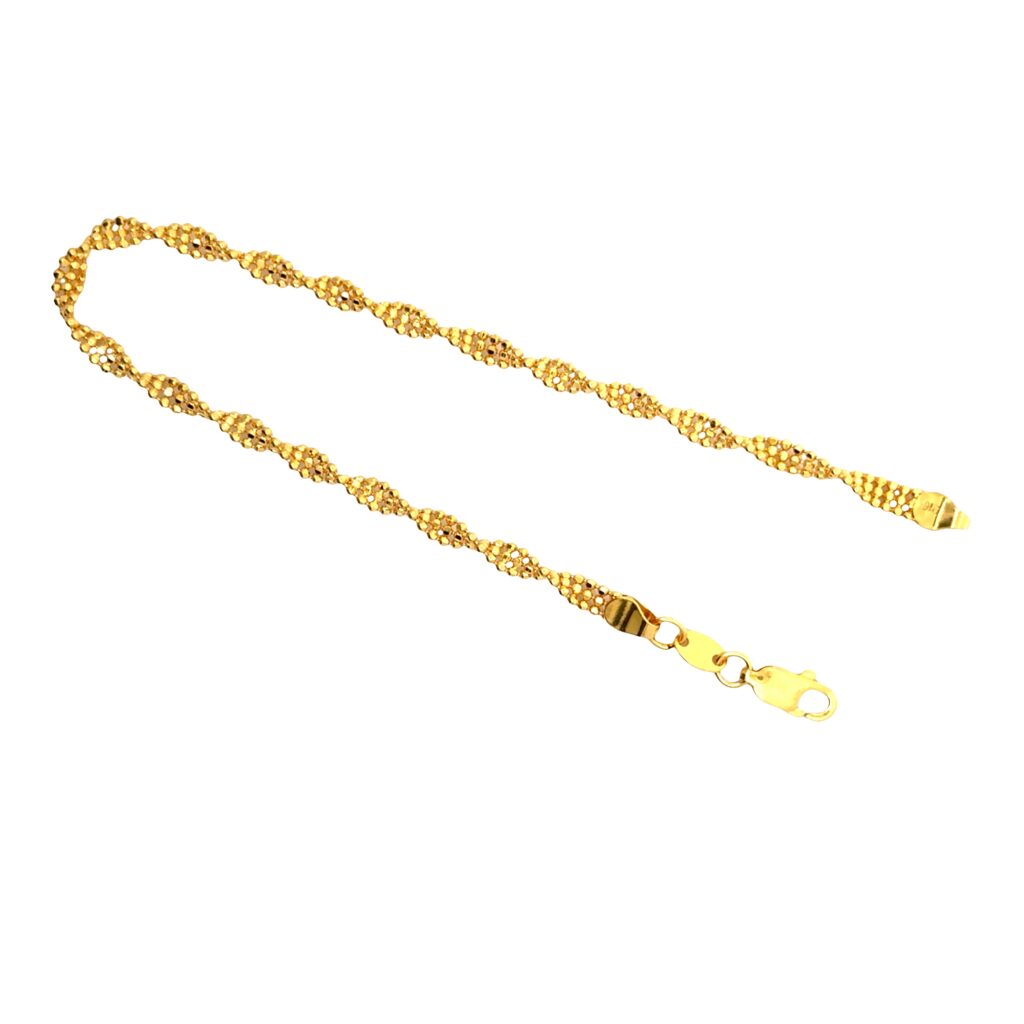
Colour should look coherent, but lighting and surface finish can create small visual differences even within 22K gold jewellery. A high-polish pendant can appear brighter beside a textured chain. We recommend judging the whole arrangement in the lighting and clothing conditions in which you expect to wear it.
The clasp must close fully, and the joining rings should look properly aligned. End fittings need to pass through the bail if you intend to remove the pendant. Before each wear, check for distorted links, thinning contact points, an opening jump ring, or a clasp that no longer springs or locks as expected.
22K gold is valued for its rich colour and high gold content, and it deserves considered handling. Avoid pulling the chain to test strength. Place the necklace on and remove it by operating the clasp, then store the chain with the pendant lying flat or separated if movement could cause rubbing.
We use a simple order: bail clearance, free movement, chain construction, weight balance, placement and clasp condition. If any one point is uncertain, we pause before combining the pieces. Our wider Hispek Diamonds 22K gold jewellery collection can help you compare compatible visual styles, and we can clarify product-specific details before you choose.
Once you have a possible combination, lay the pendant and chain flat together. Confirm that the bail sits straight, the chain is not twisted, and the clasp closes normally. Then try the pairing for a short, calm period indoors. Watch the centre position, listen for repeated contact, and check the bail again after removal. This short trial can reveal rotation, catching or poor balance that a static photograph cannot show.
How do I know whether a chain will pass through a pendant bail?
Compare the bail’s internal opening with the widest clasp or end fitting that must pass through it. Ask us when exact measurements are unclear.
Should a pendant be lighter than its chain?
The chain needs suitable strength and structure, but one fixed ratio does not suit every design. We recommend assessing the complete construction.
Can I put a 22K pendant on any 22K chain?
Matching fineness and colour does not guarantee compatibility. Bail clearance, end fittings, link structure and condition still need checking.
How can I choose the right chain length?
Measure a necklace you already like, note its placement, and account for the pendant’s height below the bail.
Modern Asian bridal jewellery trends unite heritage goldwork, diamonds and personal styling. Learn how to choose certified pieces with lasting value today.

Understand natural diamond investment value, from rarity and certification to resale realities, so you can buy a timeless stone with greater confidence.
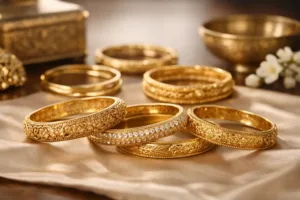
Find the best Asian gold bangles for everyday wear, weddings and gifts. Compare 22K purity, designs, fit, hallmarking and lasting value with confidence.
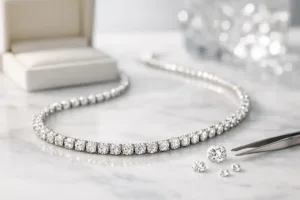
Our diamond tennis necklace guide explains carat weight, diamond quality, length and setting, helping you choose a certified necklace with confidence.
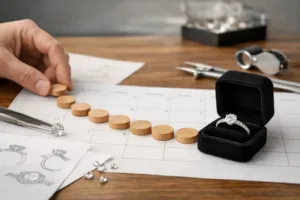
A custom engagement ring timeline example, from consultation and design approval to diamond sourcing, craftsmanship, hallmarking and delivery in the UK.
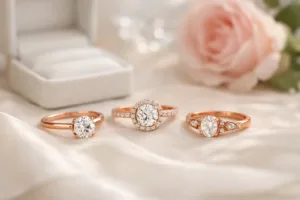
Choose rose gold engagement rings with confidence. Compare alloys, diamond colours, settings and care for a timeless, certified ring made for daily wear.