


How to Store Gold Bars Safely in the UK
Learn how to store gold bars securely at home or in a vault, with practical advice on insurance, documentation, privacy and protecting resale value safely.


When you compare two 22K gold jewellery pieces of the same weight, one can look broad and substantial while the other appears compact and dense. At Hispek Diamonds, we understand why this can feel surprising, especially when weight is one of the clearest details shown beside a piece. The difference is usually not a contradiction. Weight measures how much gold alloy is present, while visible size is shaped by the way that material is distributed.
We recommend reading weight together with width, depth, profile, link structure, and construction. A broad surface can create more visual presence without adding more mass, while a thick or closely built design can hold the same mass within a smaller outline. You can see this variety across our 22K gold jewellery collection, where form and craftsmanship give each piece a distinct scale on the body.
Gold weight tells you mass, not the exact dimensions you will see. If we spread a given amount of material across a wider, thinner form, the piece can cover more area. If we concentrate the same amount into a thicker centre or a compact motif, the visible footprint becomes smaller. The total weight can remain similar even though the proportions change considerably.
This principle applies to pendants, earrings, chains, bracelets and necklaces. A pendant with a wide open border can appear larger than a solid, rounded pendant of similar weight. A wide bracelet made with slender elements can cover more of the wrist than a narrow bracelet with dense links. Neither appearance alone reveals how the weight is distributed.
Openwork uses spaces as part of the design. Open patterns, separated motifs, and airy link arrangements can extend across a larger area while keeping the gold concentrated around the edges and decorative details. Your eye reads the full silhouette, including the open spaces, so the piece often looks larger than its mass might suggest.
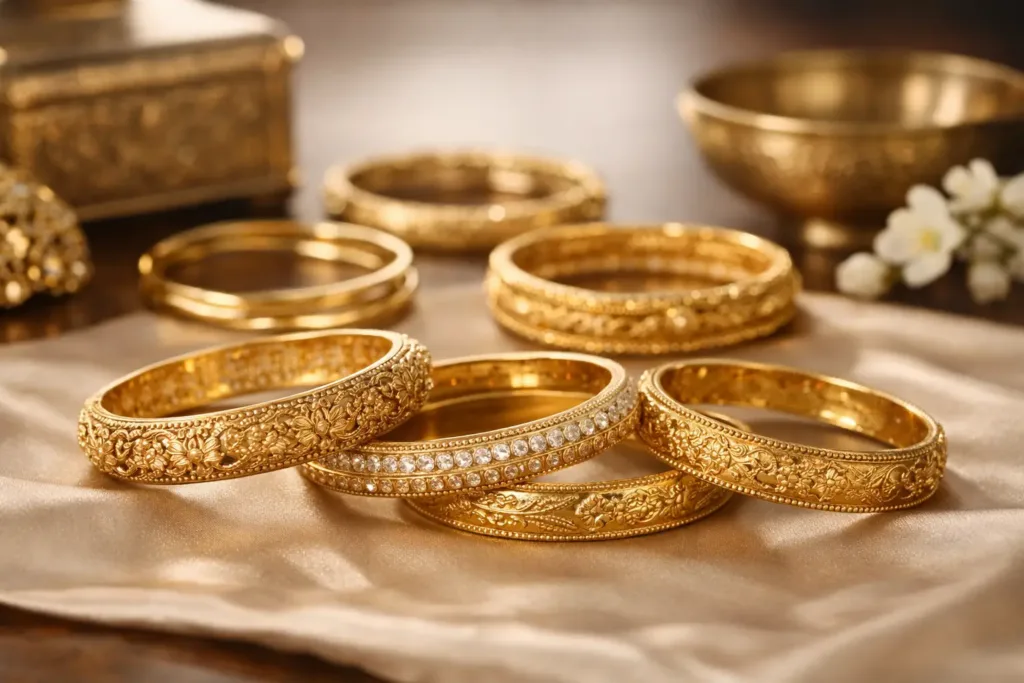
A solid design behaves differently. More of the material sits inside the outline, which can make the piece feel compact, smooth and weighty in the hand. We suggest deciding whether you prefer visual coverage or a denser presence, rather than assuming that one construction is automatically better.
A front-facing photograph mainly shows height and width. It cannot always show how much gold sits in the depth of a piece. A small domed motif, rounded link or thick-edged pendant can carry substantial mass away from the camera. A flatter design can use the same mass across a larger face and therefore look bigger from the front.
Side views are useful because profile affects both appearance and wear. Raised details can create shadow and dimension. Flat details can sit closer to the skin and show a wider uninterrupted pattern. When you compare products online, we recommend checking every available image and reading the listed measurements rather than judging from the main photograph alone.
Chains and bracelets make this especially clear. Round, tightly interlocked links can concentrate weight along a narrow line. Flattened, elongated, or more openly spaced links can create a wider visual rhythm using a comparable amount of material. Decorative stations or beads can also draw the eye beyond the physical width of the connecting links.
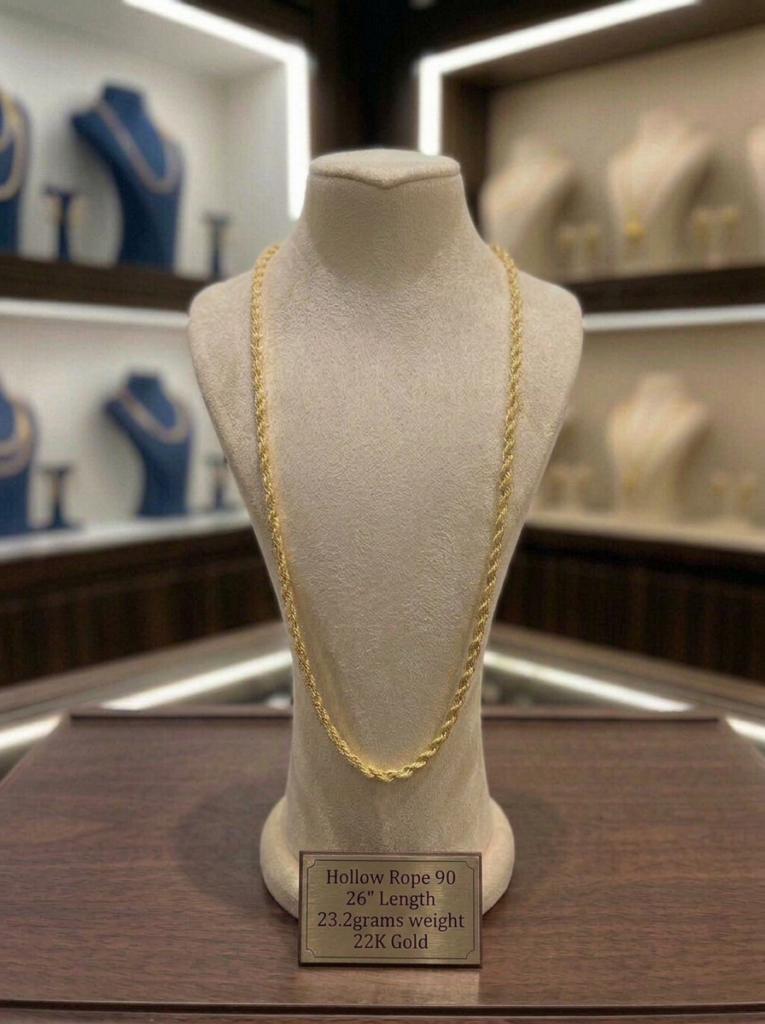
The direction of each link matters too. A link that lies flat presents more surface to the viewer. A link that turns on edge may look slimmer but feel deeper. Across our Hispek Diamonds 22K gold chains, different patterns demonstrate how construction changes visual presence as much as weight does.
Polished surfaces reflect clear highlights and can look crisp. Textured, engraved or beaded surfaces break the reflection into smaller points of light, creating intricate detail rather than one broad shine. Contrasting finishes can make edges, motifs and negative spaces easier to see, which affects the apparent scale of the design.
The warm colour of 22K gold can also look different under studio lighting, daylight and indoor lighting. We treat photographs as a helpful guide, but we do not use image scale as a substitute for dimensions. Screen size, cropping and magnification can make two pieces appear comparable even when the actual measurements differ.
Start with the listed weight, then compare length, width and depth where those measurements are available. Look at the piece beside a model, hand, neck or other scale reference. Check whether the design is solid-looking, open, flat, rounded, tightly linked or widely spaced. These observations explain far more than weight alone.
Next, consider the result you want. For noticeable coverage, you may prefer a wider or more open design. For a concentrated feel, you may prefer compact links, a thicker profile, or a solid motif. Comfort also matters: two pieces of similar weight can distribute pressure differently because one spreads across a larger area.
Our pieces are presented with product-specific information, and our hallmarking guidance explains how UK hallmarking identifies precious-metal fineness. A hallmark helps you understand metal fineness; it does not tell you the dimensions or visual spread. If a measurement or construction detail is unclear, please contact us before ordering.
Two equal-weight pieces can look different because design converts mass into shape. Width, depth, openness, link geometry and finish determine what you see. At Hispek Diamonds, we advise choosing with both the specifications and your preferred visual effect in mind. Weight is valuable information, but it becomes much more useful when you connect it to construction and proportion.
Before making a final comparison, write down the qualities that matter most to you: overall coverage, thickness, flexibility, surface detail and comfort. Then use the product measurements to test those priorities. This prevents a single number from carrying more meaning than it can provide. If two weights are close but the designs look very different, the difference is useful information about how each piece has been formed, not a reason to dismiss either option.
Does a larger-looking 22K gold piece always weigh more?
No. A wide, thin or open design can look larger than a compact design of similar or even greater weight.
Can photographs show the true size of 22K jewellery?
Photographs help you understand detail, but cropping and screen magnification can change apparent scale. We recommend checking listed measurements and scale references.
Does UK hallmarking confirm a jewellery piece’s size?
No. Hallmarking relates to precious-metal identification and fineness, not the physical dimensions or visual coverage of a design.
What should I compare besides weight?
Compare length, width, depth, link or motif structure, finish, and how the piece sits on the body.
Learn how to store gold bars securely at home or in a vault, with practical advice on insurance, documentation, privacy and protecting resale value safely.

Lab diamond demand trends in 2025 reflect shifting values on price, design and ethics, with buyers comparing certification, quality and resale.

Learn how to buy 22k gold chains with confidence. Compare purity, weight, hallmarking, styles, pricing and fit before you choose.
Wedding jewellery trends 2026 favour personal design, mixed metals, bold pearls and certified diamonds with lasting value for modern couples.

Learn how to clean gold jewellery safely at home, protect stones and plating, and keep your pieces bright without causing avoidable damage.
Find diamond anniversary gifts that balance beauty, meaning and value, with expert tips on rings, pendants, earrings and bespoke options.