

Can Rings Be Resized? What to Know First
Can rings be resized? Learn which metals and settings can be altered, what affects the cost, and when expert remodelling is the safer choice for rings.

A bracelet set with a long run of diamonds asks different questions from a ring or a pair of earrings. There’s no single centre stone to judge. Instead you’re weighing the metal that holds everything together, a row of smaller diamonds, and how the whole piece sits on your wrist.
If a diamond bracelet is on your list, it helps to know which details really tell you something and which ones you should ask about before you buy. Here’s how we’d suggest working through them.
Choosing a diamond bracelet involves more than comparing the stones. Start with the metal that holds every stone in place, then judge the diamonds, then ask about arrangement and fit.
Precious metals like platinum, gold, palladium and silver are rarely used in their purest form. They’re typically alloyed with other metals to achieve the strength, durability and colour a piece needs. In a bracelet that holds many diamonds and moves with your wrist, that strength and durability are worth considering alongside the setting and fit.
Colour plays its part too. A white metal such as platinum or white gold can enhance a diamond’s appearance, so the setting isn’t just a frame. It shapes how the diamonds look against it.
You can’t judge precious metal content by sight or touch. That’s why, in the UK, items made of platinum, gold, palladium or silver generally need hallmarking if they’re sold as such, above weight thresholds of 0.5 grams for platinum, 1 gram for gold and palladium, and 7.78 grams for silver. Manufacturers and importers can’t apply hallmarks themselves: goods must be submitted to one of the four UK Assay Offices, or an Assay Office affiliated with the International Convention.
We have our precious metal products hallmarked in accordance with applicable UK requirements. Our laser hallmarks identify our unique sponsor mark, the precious metal content and the assay office. Nascoglobal Limited, trading as Hispek Diamonds, is registered with the Birmingham Assay Office, and you’ll find more detail on our Hallmarking page.
When a bracelet contains several small diamonds, it’s worth asking about their clarity grades as well as their arrangement. SI2 is one grade commonly associated with smaller jewellery stones, although the right choice depends on the individual diamonds and design. Most inclusions can’t be seen with the naked eye, but it’s still worth asking how the stones in a particular bracelet are graded.
Cut quality has a major influence on a diamond’s sparkle, with grades ranging from Excellent to Poor. A well cut diamond can appear brighter and may look larger than a poorly cut diamond of similar carat weight, depending on its proportions. Colour matters as well. Diamonds are graded from D, colourless, to Z, light yellow or brown. When comparing bracelets with several diamonds, ask about the colour grades of the stones used and how they look together.
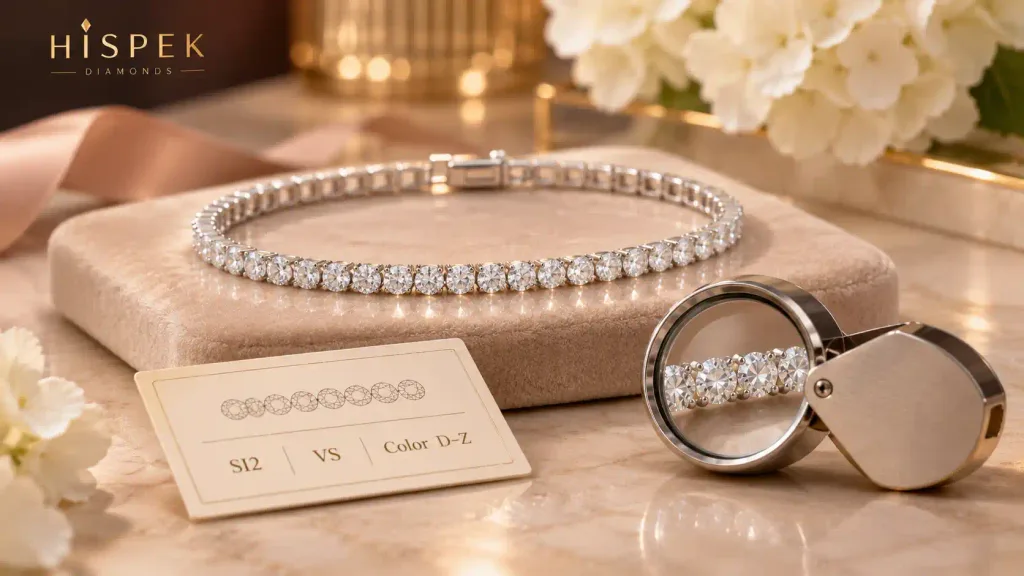
The way the diamonds are arranged and the way the bracelet fits are specific to each design, so ask about them directly. How many diamonds does it hold, and what’s their total carat weight? What length is it, and how does it fasten? How are the stones set? A clear answer to each one tells you far more than a photo can.
Our product enquiry form lets you choose Bracelets/Bangles as the range you’d like more information on and send us your questions. If you’d rather talk in person, you can book an appointment with our jewellery consultants, who have many years of experience in selling luxury products.
You don’t have to decide on natural diamonds by default. Our Lab Grown Diamond Jewellery includes bracelets, so you can compare both before you decide. If you prefer natural stones, we source our natural diamonds in line with the conflict free standards defined by the Kimberley Process. You can ask us about the grading information available for the bracelet you’re considering.
A diamond bracelet is worth judging by the combination behind it: the metal and its applicable hallmarking requirements, the quality and arrangement of the diamonds, and a design that fits you. Start by browsing our Diamond Bracelets, then bring your questions about arrangement and fit straight to us.
Need help? Book An Appointment, or call us on +44 203 965 6669.
Is the metal in a diamond bracelet pure?
Rarely. Precious metals like platinum, gold, palladium and silver are typically alloyed with other metals to achieve the strength, durability and colour a piece needs.
Does a diamond bracelet need a hallmark?
In the UK, precious metal items generally need hallmarking above set weight thresholds, such as 1 gram for gold and 0.5 grams for platinum. Our precious metal products are hallmarked in accordance with those requirements, with marks identifying our sponsor mark, the metal content and the assay office.
What clarity grade makes sense for the small diamonds in a bracelet?
SI2 is one clarity grade commonly associated with smaller jewellery diamonds, although the right grade depends on the individual stones and design. Many small inclusions are difficult to see without magnification, but their visibility varies.
How can I find out about a bracelet’s length, diamonds and fastening?
Use our product enquiry form and choose Bracelets/Bangles, or book an appointment with our jewellery consultants. You can also call +44 203 965 6669.