

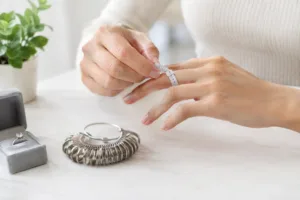
Ring Size Measurement for a Comfortable Fit
Ring size measurement made simple: learn how to measure at home, avoid common fit mistakes and choose a comfortable ring with confidence before buying.

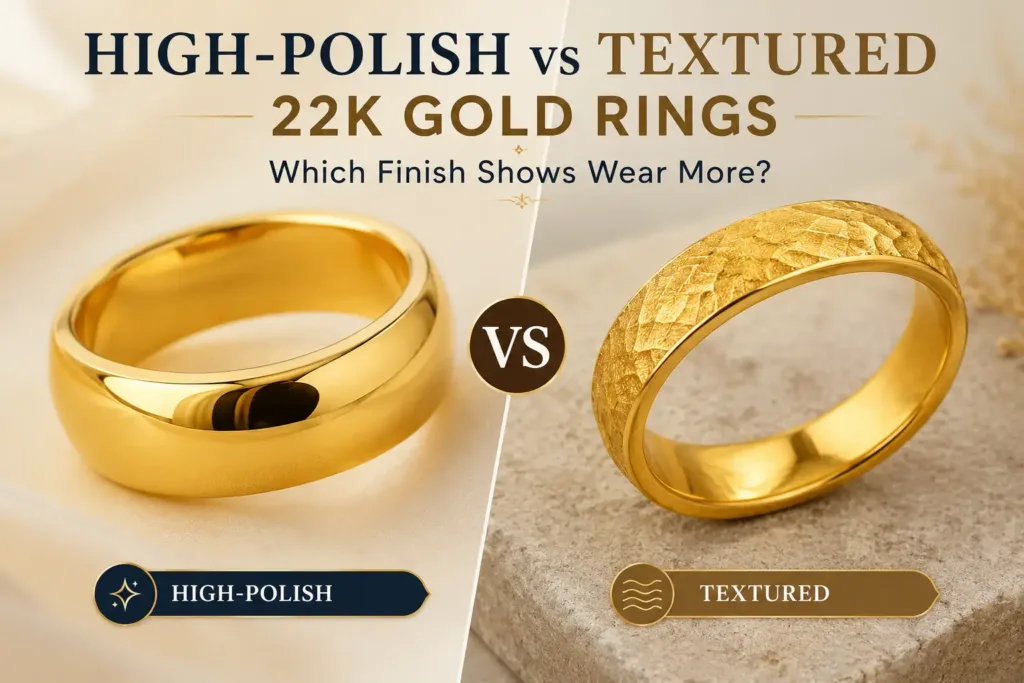
When comparing high-polish vs textured 22K gold rings, a high-polish surface will usually make fine scratches and scuffs easier to notice because those marks interrupt an otherwise smooth, reflective finish. A textured finish can visually disguise minor surface marks for longer, but it develops wear differently. With repeated contact, parts of the original texture can become smoother or shinier.
That distinction matters with 22K gold because higher-karat gold is softer than lower-karat gold alloys and is therefore more susceptible to scratches and dents. The finish does not change the underlying gold purity. It changes how the surface reflects light and how easily normal wear can be seen. GIA notes that higher-karat gold is softer and more prone to surface damage than lower-karat alloys.
For small scratches and light abrasions, high polish generally shows wear sooner. For a textured ring, minor marks can blend into the existing surface pattern, but repeated rubbing may gradually change the texture itself.
This does not mean a textured ring is harder or that a polished ring physically wears faster simply because of its finish. Both are still made from the same underlying gold alloy when purity and construction are otherwise equal.
The better comparison is:
| Attribute | High-Polish 22K Gold | Textured 22K Gold |
| Initial appearance | Smooth and highly reflective | Diffused, patterned or deliberately irregular |
| Fine scratches | Usually easier to see | Often less visually obvious |
| Light scuffs | Can interrupt the mirror-like surface | Can blend into existing texture |
| Repeated rubbing | Can create fine surface marks | Can smooth or brighten raised areas |
| Deep scratches or dents | Visible | Still visible |
| Main change over time | Loss of uniform polish | Loss or alteration of original texture |
Jewellery finishing specialists have long noted that consistent satin or textured surfaces can take longer to look visually damaged than a high-polish finish because new minor scratches are less distinct from the existing surface treatment.
A high-polish finish depends on having a very smooth surface that reflects light cleanly.
When a scratch crosses that surface, the scratch changes the way light reflects from that small area. Against a mirror-like background, even a fine line can therefore become noticeable, particularly under strong directional light.
This is why a polished ring can still be structurally sound while beginning to look visibly worn.
The effect is similar to a polished metal panel. A tiny abrasion may not remove much material, but because the surrounding surface is uniform and reflective, the disruption attracts attention.
For a buyer who prefers a consistently bright, reflective appearance, this means normal surface maintenance may become more visually important over time.
A textured finish can make minor scratches and scuffs less obvious because the surface already contains deliberate lines, depressions, stippling, brushing or other variations.
Instead of every new mark interrupting a perfectly smooth field, a light abrasion may visually merge with the surrounding texture.
That is one reason textured finishes can be useful for people who do not want every small surface mark to become immediately noticeable.
However, “hides wear better” does not mean “does not wear.”
The texture itself becomes the feature that must be preserved.
With regular contact, you may begin to see:
A textured ring therefore tends to show wear through changes in the pattern, while a polished ring tends to show it through interruptions in reflectivity.
Yes. Repeated friction can gradually reduce the contrast of some surface textures.
Imagine a ring with a deliberately brushed, stippled or patterned surface. The highest points receive the most direct contact with desks, tools, clothing, bags and other objects. Over time, those contact areas can become smoother compared with protected recesses.
The result can be a mixed surface where one part remains textured and another begins to look polished or burnished.
This is especially important when the texture is very fine. The finer the visual difference between raised and recessed areas, the more noticeable localised smoothing may eventually become.
More pronounced decorative patterns may remain visually recognisable even when individual high points develop wear, but the exact outcome depends on the design and construction of the individual ring.
The finish question cannot be separated completely from the 22K gold itself.
Higher-karat gold contains a greater proportion of gold, and GIA explains that higher-karat gold is softer and more prone to scratches and dents than lower-karat gold alloys.
That means both finishes need realistic expectations.
A high-polish 22K ring can develop fine scratches that become visible against the reflective surface.
A textured 22K ring can collect similar surface wear, but some of those marks may initially blend with the texture. Over longer use, pressure and friction can also alter the original finish.
The finish does not remove the care considerations associated with high-karat gold.
This is where the comparison becomes particularly useful.
Some 22K ring designs use both polished and textured surfaces to create visual contrast. One current HiSpek Diamonds 22K Kolkata ring, for example, is described as having a high-polish filigree gallery together with textured scrolls and diamond-cut circular motifs. The product is listed at 2.39g, in 22K gold with 916 purity.
On a mixed-finish ring like this, wear may become visible differently from one section to another.
The polished areas may reveal fine hairline scratches through changes in reflection. Textured sections may continue to disguise small marks but can gradually become smoother at frequently contacted points.
This is also why buyers should look at the whole ring design, rather than choosing solely between the labels “polished” and “textured.”
The location of each finish matters.
A recessed texture may receive less direct contact than a raised polished edge. A broad polished band may show more everyday scuffing than a small polished detail protected by surrounding decoration.
If your main concern is how quickly small scratches become visually noticeable, a textured finish generally has an advantage.
If your priority is a bright, smooth and reflective gold surface, high polish provides that appearance, but normal surface marks may be easier to see.
The decision can be simplified like this:
Choose high polish if you prefer:
Consider texture if you prefer:
Neither option eliminates the need to protect a 22K gold ring from hard impacts and abrasive contact.
Not necessarily.
Texture is most useful for reducing the visual prominence of small surface marks. A deep scratch, dent or gouge can still interrupt a textured pattern and may be very noticeable.
In some cases, a deep mark can be more visually disruptive on an intricate textured ring because it cuts across the intended design.
The practical distinction is therefore between minor cosmetic wear and more significant physical damage.
A finish can influence how cosmetic wear looks. It cannot make a substantial dent disappear.
Polishing is a recognised maintenance process for gold jewellery, and GIA notes that gold rings may need polishing to remove scratches.
However, refinishing should be approached according to the actual ring.
Polishing is an abrasive process, so repeated or aggressive polishing is not something to treat as routine home cleaning. Rings with decorative detailing, filigree, diamond-cut areas or a combination of finishes require particular care because changing one surface can affect the contrast with another.
Textured finishes also require the correct finishing technique if their original appearance is to be recreated.
For an intricate 22K ring, professional assessment is preferable when visible wear becomes significant.
When comparing two rings, inspect more than whether one looks shiny and the other looks textured.
Consider:
HiSpek Diamonds’ current 22K gold rings collection includes Kolkata style, band and other ring designs, with individual product listings showing different weights and size options. The category also states that its 22K rings are UK hallmarked.
If your question is simply which finish shows wear more, high-polish 22K gold usually makes small scratches and scuffs easier to notice because they disrupt a smooth reflective surface.
A textured finish can disguise minor marks more effectively, but over time its own pattern can begin to smooth or brighten in areas that receive repeated contact.
For 22K gold, the more useful buying question is therefore not “Which finish will never show wear?” Neither will. Instead, consider which type of visible ageing you prefer and how the finish works with the ring’s actual design.
At HiSpek Diamonds, you can compare 22K gold rings by design, weight and available ring size, including pieces that combine polished surfaces with more intricate textured details.
Higher-karat gold is softer than lower-karat gold alloys and can develop scratches and dents. On a high-polish surface, fine scratches can be particularly noticeable because they interrupt the smooth reflection.
Yes. A textured finish does not prevent scratches. It can make small surface marks less visually obvious because they blend into the existing pattern, while larger scratches can still be clearly visible.
No. Finish and gold purity are different attributes. Texturing changes the appearance of the surface, but it does not turn 22K gold into a lower-karat or inherently harder alloy.
Areas exposed to repeated friction can gradually become smoother or more burnished, so parts of a textured surface may appear shinier than they originally did.
If hiding minor visible scratches is the priority, texture can be more forgiving. If strong shine and reflection are the priority, high polish may be preferable, with the understanding that small surface marks can become easier to see.
Ring size measurement made simple: learn how to measure at home, avoid common fit mistakes and choose a comfortable ring with confidence before buying.
When comparing high-polish vs textured 22K gold rings, a high-polish surface will usually make fine scratches and scuffs easier to notice because those marks interrupt…

Use this gold portfolio allocation example to compare 5%, 10% and 15% holdings, choose suitable bullion and weigh risks before you buy with confidence.

You can physically wear a 22K gold ring while showering, swimming or exercising, but removing it first is generally the safer care routine. Higher karat…

Gold investment explained for UK buyers: compare 24K bars, coins and jewellery, understand VAT, premiums, storage and the checks that protect your purchase.

A 22K gold ring can be considered for personalisation through engraving, but the decision should be made for the specific ring rather than assuming every…
