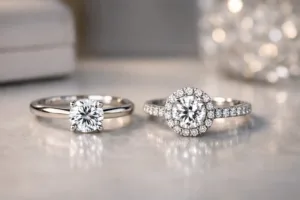
Solitaire vs Halo Engagement Rings Compared
Compare solitaire vs halo engagement rings by sparkle, budget, protection and everyday wear, so you can choose a certified diamond ring with confidence.
We Buy Gold . Top Prices Paid .
7 Day Price Promise .
30 Day Returns
Free World Wide Shipping
Life Time Warranty
We Buy Gold . Top Prices Paid .
7 Day Price Promise .
30 Day Returns
Free World Wide Shipping
Life Time Warranty

+44 203 965 6669

A gold price outlook is most useful when it helps you make a better buying decision, rather than encouraging you to chase a headline. Gold can rise sharply when markets are unsettled, but it can also pause or fall when sterling strengthens, interest-rate expectations change, or investors move back towards risk assets. For UK buyers, the price on any given day is only part of the picture.
Whether you are considering 24K investment gold, a meaningful 22K jewellery piece or a bespoke engagement ring with gold as part of its value, confidence starts with understanding what actually moves the market. Gold has a long history as a store of value, but its short-term direction is never guaranteed.
The international gold market is generally quoted in US dollars per troy ounce. That means the gold price seen by a UK customer is shaped by two moving parts: the global gold price and the pound-to-dollar exchange rate. A rising dollar gold price does not always translate into the same increase in pounds, and a weaker pound can make gold more expensive for UK buyers even if the international price is steady.
Interest rates are another major influence. Gold does not pay interest or dividends, so higher real interest rates can reduce its appeal compared with cash savings or government bonds. Conversely, when markets expect interest-rate cuts, lower returns on cash, or persistent inflation, demand for gold can increase. The relationship is not mechanical, but it is one of the clearest themes to watch.
Geopolitical uncertainty also matters. Conflict, trade disruption, banking concerns and political instability can lead investors to seek assets perceived as defensive. Central-bank buying has added another important layer in recent years, with many institutions increasing gold reserves to diversify away from reliance on individual currencies.
Finally, physical demand plays a role. Demand for bars and coins, jewellery buying in major consumer markets, recycling activity and mine supply all affect the wider market. These factors often move more gradually than currency or interest-rate news, yet they can support the longer-term case for gold.
For a UK buyer, exchange rates deserve close attention. If sterling weakens against the US dollar, the pound price of gold may rise even without a dramatic move in the global spot price. If sterling strengthens, the reverse can happen.
This is why it is risky to judge timing from a US news headline alone. A report that gold has reached a record dollar price may not mean that the UK price is at its highest point. Equally, a modest international rise can matter more to a buyer paying in pounds when exchange-rate movements are working in the same direction.
The product itself also affects the final price. Spot price is the underlying value of gold before fabrication, refining, logistics, insurance and retail costs. A 24K bullion bar will usually carry a smaller premium over its gold content than a detailed gold bracelet or diamond-set ring, because jewellery includes craftsmanship, design, settings and, where applicable, gemstones.
That distinction is not a drawback. Bullion and jewellery serve different purposes. A hallmarked gold chain can be both wearable and valuable, while an LBMA-approved 24K gold bar is designed primarily for customers who want direct exposure to the precious metal. The right choice depends on whether your priority is investment, a special occasion, personal style, or a blend of all three.
No one can provide a certain price target for gold. A more useful approach is to consider the conditions that could support different outcomes.
Gold may remain well supported if inflation proves difficult to contain, real yields fall, the pound weakens, central banks continue to accumulate reserves, or geopolitical risks remain elevated. In this setting, investment demand can stay strong, particularly if buyers feel that conventional assets are carrying greater uncertainty.
This does not mean prices rise in a straight line. Even in a constructive market, gold can experience sharp pullbacks when investors take profits or economic data changes expectations for interest rates.
Gold can also trade within a broad range when markets receive mixed signals. For example, inflation may be easing while geopolitical risks remain unresolved, or rate-cut expectations may be balanced by a stronger pound. This environment can frustrate those waiting for a perfect entry point, because opportunities may be brief and hard to identify in advance.
For buyers building a long-term holding, staged purchases can be a practical alternative to committing all funds on one day. Buying in measured amounts over time reduces the pressure of trying to call the exact market low. It does not guarantee a better price, but it can make the decision more disciplined.
Gold may come under pressure if real interest rates stay high, the US dollar strengthens materially, inflation concerns fade and investor confidence returns strongly to equities and other risk assets. A firmer pound could also make gold more affordable in sterling terms, even where the dollar price is unchanged.
A lower price is not automatically a signal to buy, just as a higher price is not automatically a signal to sell. It should be assessed against your reason for owning gold, your budget and the proportion of your wider savings or investment portfolio allocated to precious metals.
Investment gold should be straightforward to understand. Start by confirming purity, weight and the product’s recognised standard. 24K gold is typically 999.9 fine gold, meaning it contains 99.99% gold. The weight should be stated clearly in grams or troy ounces, alongside the live selling price and any premium.
For eligible investment gold in the UK, qualifying gold bullion is generally VAT exempt. This can make bars and certain qualifying coins more efficient for buyers whose purpose is precious-metal exposure rather than adornment. Jewellery does not receive the same VAT treatment, because it is a finished consumer product rather than investment gold.
It is equally important to consider resale. Recognised, high-purity products from respected refiners are widely understood in the market, which can support a simpler resale process. Keep your invoice, product documentation and packaging where supplied. Storage should be planned before purchase, whether that means secure home storage, a specialist vault or another suitable arrangement.
Price transparency matters too. Look beyond the headline rate and understand the full cost of the item, including premium, delivery and any applicable service charges. A reputable retailer should make the product specification clear and provide confidence in authenticity, secure delivery and customer support.
At Hispek Diamonds, customers seeking 24K investment gold can select premium bullion with clear specifications and the reassurance of expert assistance alongside fine jewellery and bespoke services. For a significant purchase, asking questions before you buy is not hesitation – it is good judgement.
Gold jewellery should not be valued only by its scrap content. The gold fineness, weight, hallmark, craftsmanship, design, gemstone quality and condition all contribute to what a piece represents. A timeless 18K engagement ring, a substantial 22K bangle or a carefully chosen gift may retain an underlying gold value while carrying emotional and aesthetic value that a bullion bar cannot offer.
UK hallmarking is particularly helpful. It provides an independent indication of the metal’s fineness, allowing buyers to understand whether a piece is 9K, 14K, 18K or 22K gold. When comparing jewellery, check the carat, total weight, workmanship and any diamond certification rather than assuming two visually similar pieces offer the same value.
If your primary aim is gold exposure, bullion is normally the clearer route. If you want something to wear, gift or pass down, fine jewellery may be the more rewarding purchase. There is room for both, provided expectations are realistic.
Avoid treating daily price movements as a test of whether you made the right decision. Gold is often held as a long-term diversifier and a tangible asset, not as a shortcut to quick returns. Decide what role it should play before looking at charts: preserving purchasing power, diversifying a broader portfolio, marking a life event, or owning a beautiful piece with lasting material value.
Set a budget you are comfortable with, compare like-for-like products and buy from a retailer that is transparent about purity, certification and pricing. If you are investing a substantial amount, independent financial advice may be appropriate, especially where gold forms part of a wider retirement or investment plan.
The most considered gold purchase is rarely made because of one dramatic market move. It is made with a clear purpose, a trusted product and the confidence that the piece you choose suits both the moment and the years ahead.
Compare solitaire vs halo engagement rings by sparkle, budget, protection and everyday wear, so you can choose a certified diamond ring with confidence.

Our guide to gold purity levels explains carats, hallmarks and value, helping you choose jewellery or investment gold with complete confidence in the UK.

Choose diamond rings with confidence. Compare natural and lab-grown diamonds, cuts, settings, certification and metals for a ring made to last for years.

Choose silver chains for men with confidence: compare sterling silver styles, lengths, widths and care for polished everyday or occasion wear with ease.

Modern Asian bridal jewellery trends unite heritage goldwork, diamonds and personal styling. Learn how to choose certified pieces with lasting value today.

Understand natural diamond investment value, from rarity and certification to resale realities, so you can buy a timeless stone with greater confidence.