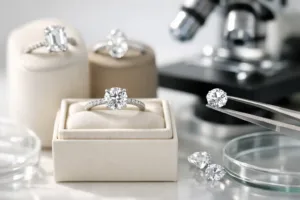
Lab Grown Engagement Ring Trends for 2026
Lab grown engagement ring trends for 2026 reveal shifts in cuts, settings and buyer priorities, from larger stones to bespoke, ethical design.
We Buy Gold . Top Prices Paid .
7 Day Price Promise .
30 Day Returns
Free World Wide Shipping
Life Time Warranty
We Buy Gold . Top Prices Paid .
7 Day Price Promise .
30 Day Returns
Free World Wide Shipping
Life Time Warranty

+44 203 965 6669
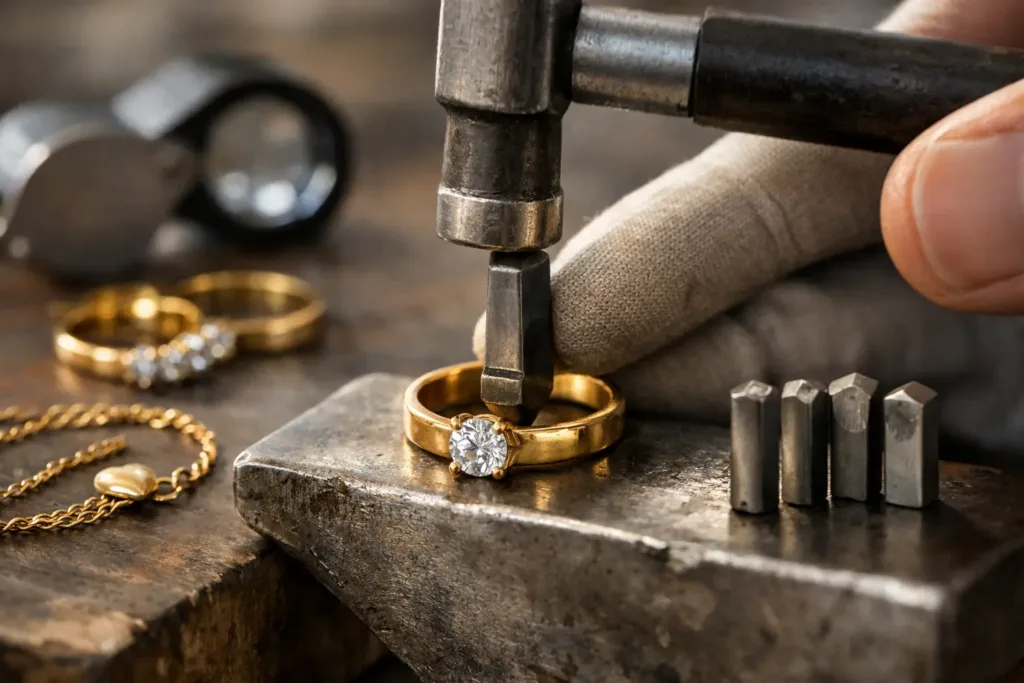
A gold ring can look substantial, feel beautifully made and still leave one key question unanswered: what is it actually made from? A gold purity stamps guide helps you read the small marks that confirm a piece’s precious-metal content, giving you greater confidence before you buy, gift, insure or sell fine jewellery.
For UK buyers, these marks are more than decorative details. A proper hallmark offers independent reassurance that a gold item meets the stated standard. Whether you are choosing a timeless 18K engagement ring, a traditional 22K bangle or 24K investment gold, understanding the stamp helps you compare value on a like-for-like basis.
The most useful mark on a gold item is usually its fineness number. This tells you how many parts of the metal are pure gold out of 1,000. The higher the number, the higher the proportion of gold.
A stamp of 375 means 375 parts pure gold per thousand, which is the same as 9 carat gold. 585 represents 14 carat gold, while 750 is 18 carat. A 916 stamp identifies 22 carat gold, and 999 or 999.9 is associated with very high-purity, investment-grade gold.
Carat and fineness express the same idea in different ways. Carat uses a scale of 24, while fineness uses a scale of 1,000. Pure gold is 24 carat in principle, but jewellery described as 24K may be marked 999 or 999.9 because absolute purity is difficult to achieve and verify in practice.
Here is how the most common UK gold purities compare:
The remaining proportion is made up of other metals, known as alloys. These are deliberately added to improve strength, alter colour and make gold more suitable for everyday wear. That is why an 18K white gold ring, an 18K yellow gold ring and an 18K rose gold ring can all carry a 750 mark while looking distinctly different.
Higher gold content generally means greater intrinsic metal value, but it does not automatically make one piece the right choice for every purpose. The best purity depends on how the jewellery will be worn, its design and your priorities.
Nine carat gold is a popular choice for affordable luxury. It contains less gold than 18K, yet its alloy content can make it practical for regular wear, particularly in chains, earrings and more accessible jewellery designs. Eighteen carat gold offers a richer colour and higher precious-metal content, making it a classic choice for engagement rings, wedding bands and heirloom pieces.
Twenty-two carat gold has a deep, warm yellow tone that is especially valued in traditional and Asian gold jewellery. It carries significantly more gold than 18K, though its softness means intricate settings and fine claws require thoughtful design and care. A broad 22K bangle may be ideal for occasion wear and gifting, while an 18K diamond ring is often better suited to protecting delicate stone settings over many years.
For bullion, purity is central. Investment gold bars are typically refined to 999.9 fineness. Unlike jewellery, where craftsmanship, style and gemstone setting influence the price, bullion is valued primarily by its weight, purity and current gold market price.
A UK hallmark is often a compact group of marks rather than one number. On a fully hallmarked item, you may see a sponsor’s mark, a fineness mark and an assay office mark. Some pieces also include a traditional fineness symbol or an optional date letter.
The sponsor’s mark identifies the business responsible for submitting the item for hallmarking. This may be a manufacturer, wholesaler, importer or retailer. It is usually made up of initials or a registered symbol within a distinctive shape.
The fineness mark is the number such as 375, 585, 750 or 916. This is the clearest indicator of gold purity and should be your starting point when comparing pieces.
The assay office mark shows which UK assay office tested and hallmarked the item. UK assay offices include London, Birmingham, Sheffield and Edinburgh, each with its own recognised symbol. Their presence provides valuable third-party assurance rather than relying solely on a seller’s description.
A traditional mark may also appear. For gold, this has historically been a crown-shaped symbol, although modern hallmarking commonly relies on the numerical fineness mark. Date letters can help identify when an item was hallmarked, but they are optional and do not always appear on new jewellery.
Hallmarks are usually discreet. Check the inside of a ring shank, the clasp of a necklace or bracelet, the back of an earring, the bail of a pendant or the edge of a bangle. On very fine pieces, a jeweller’s loupe or your mobile phone camera’s close-up setting can make the marks easier to read.
Not every stamp is a UK hallmark. This distinction matters, especially when buying pre-owned jewellery, shopping overseas or reviewing an item offered online without clear documentation.
A piece may be stamped “18K”, “750” or “14K” without carrying the full set of UK hallmark marks. The stamp may be legitimate, but it has not necessarily been independently verified through the UK hallmarking process. For a higher-value purchase, ask for clear images of the marks, a detailed product specification and confirmation of whether the item is UK hallmarked.
UK law requires most qualifying precious-metal articles above specified weight thresholds to be hallmarked before sale. Very small items can be exempt, and vintage or imported pieces may have different marks. Exemption should not be treated as proof of poor quality, but it does mean buyers should seek additional reassurance from a reputable retailer, receipt, valuation or professional assessment.
For jewellery sold as gold-plated, gold-filled or vermeil, the rules are different again. Terms such as GP, GEP, HGE and rolled gold refer to a layer of gold applied over another base metal. They do not mean the whole item is solid gold. A plated item can offer an attractive finish at a lower price, but its long-term value, durability and resale characteristics are not comparable with solid 9K, 18K or 22K gold.
Start by looking for the fineness number and matching it to the stated carat. If a product is described as 18K gold, expect to see 750; if it is 22K, look for 916. Small variations in the appearance or placement of marks are normal, particularly on handmade jewellery, but the stated purity and fineness should always agree.
Next, consider the item as a whole. A hallmark verifies metal purity, not diamond quality, gemstone authenticity, condition or workmanship. A premium diamond ring should also be assessed for its setting, stone certification where applicable, proportions, finish and aftercare support. For investment bullion, confirm the bar’s weight, fineness, refiner credentials and packaging alongside its markings.
Be cautious if a stamp is blurred, badly aligned, unusually shallow or inconsistent with the item’s claimed origin. Wear can soften marks on older jewellery, so an unclear stamp is not automatic evidence of a problem. However, where the value is significant, an independent jeweller or assay office can provide a more reliable assessment than visual inspection alone.
Buyers sometimes assume that yellow gold is purer than white gold, or that a heavier ring must be higher carat. Neither is always true. Gold colour comes from the alloy mix, while weight reflects the amount of metal used in the design. Purity is confirmed by the hallmark or fineness stamp.
For example, a substantial 9K signet ring may weigh more than a delicate 18K solitaire ring, yet the 18K ring contains a higher proportion of pure gold. Its final price may also be influenced by a certified diamond, bespoke craftsmanship or platinum setting details. This is why purity stamps are essential, but should be read alongside weight, design and the quality of any gemstones.
When selecting gold jewellery, choose the purity that fits the moment as well as the budget. A well-made, properly hallmarked piece gives you the reassurance to enjoy its beauty now and understand its value for years to come.
Lab grown engagement ring trends for 2026 reveal shifts in cuts, settings and buyer priorities, from larger stones to bespoke, ethical design.

Choose gold jewellery with confidence. Learn about purity, hallmarking, style, value and care before you buy for gifting, weddings or wear.
Use our diamond carat size guide to compare popular weights, understand face-up size, and choose a certified diamond with confidence.

Find engagement rings with confidence. Learn how to compare diamonds, settings, metals and value, with expert guidance for every budget.

Gold investment trends UK buyers are watching now include smaller bars, inflation hedging and trusted sourcing for long-term security.
Comparing 9k vs 18k gold? Learn the key differences in purity, colour, durability, price and value so you can choose the right gold jewellery.