We Buy Gold . Top Prices Paid .
7 Day Price Promise .
30 Day Returns
Free World Wide Shipping
Life Time Warranty
We Buy Gold . Top Prices Paid .
7 Day Price Promise .
30 Day Returns
Free World Wide Shipping
Life Time Warranty

- Shop Luxury Diamond Jewellery in the UK
- 22K GOLD JEWELLERY
- Buy Traditional 22K Gold Pendants
- 22K Gold Rings for Men & Women Leicester | Hispek Diamonds
- Shop 22K Gold Necklaces Leicester | Hispek Diamonds
- Buy Stunning 22K Gold Chains Online in the UK
- Buy 22K Gold Bracelets for Women in UK
- Buy 22K Gold Earrings for Women Leicester | Hispek Diamonds
- 22K Gold Bangles Collection Leicester | Hispek Diamonds
- Buy 22K Gold Necklace & Earring Sets
- Buy Traditional Kolkata style 22K Gold Karas
- 18K GOLD JEWELLERY
- SILVER JEWELLERY
- 24K GOLD BULLION
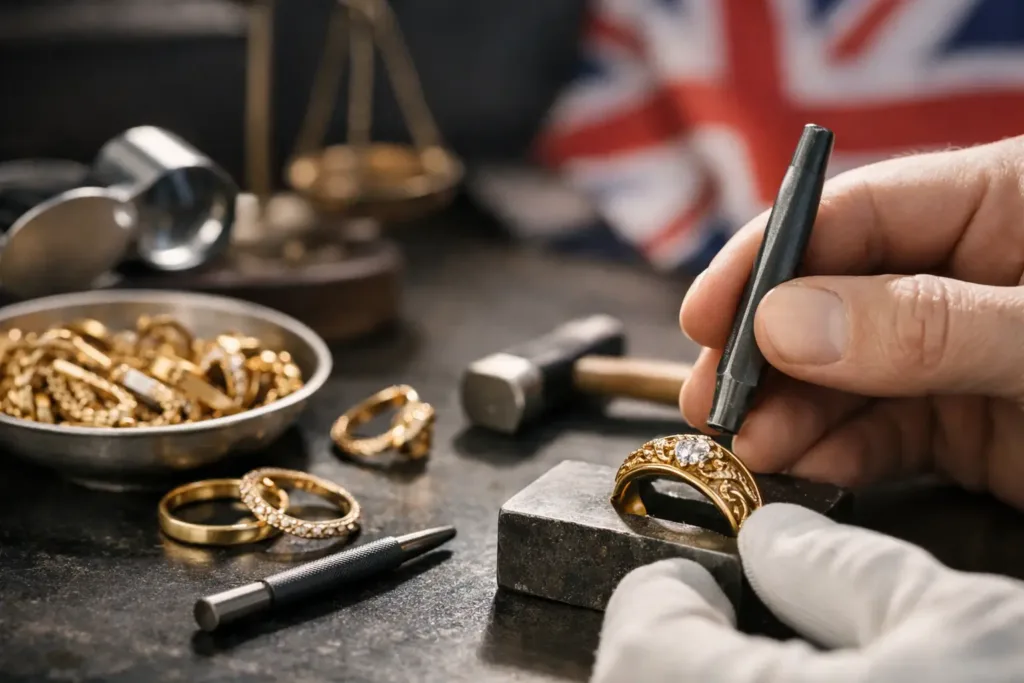
A gold chain can look substantial, feel weighty and still leave a buyer with one key question – is it really what it claims to be? That is where UK hallmarking on gold jewellery matters. For anyone buying a wedding band, a gift, a statement bangle or a long-term piece to treasure, hallmarking is one of the clearest trust signals you can ask for.
In the UK, hallmarking is not a decorative extra. It is a legal system designed to protect buyers and keep standards high across the jewellery trade. When you are investing in fine gold jewellery, especially online or from overseas, that small set of marks can tell you a great deal about authenticity, metal purity and who has taken responsibility for the piece.
What UK hallmarking on gold jewellery actually means
A hallmark is an official series of marks applied to precious metal items by an authorised UK Assay Office. For gold jewellery, these marks confirm that the item has been independently tested and that its gold content meets the legal standard stated.
That independent verification is what gives hallmarking real value. A retailer can describe a ring as 18ct gold, but a hallmark means the metal has been assessed by a recognised authority rather than simply labelled by the seller. For customers making a high-value purchase, that distinction matters.
In practical terms, hallmarking helps you separate genuine fine jewellery from pieces that are misleadingly described, under-alloyed or simply not of the purity advertised. It also supports resale confidence, insurance valuations and long-term peace of mind.
When hallmarking is legally required in the UK
The UK has some of the strictest precious metal regulations in the world. Gold items above a certain weight must be hallmarked before they can legally be described or sold as gold in the UK.
For gold, the threshold is 1 gram. If a gold jewellery item weighs more than that, it generally needs a UK hallmark if it is being sold as gold. Pieces below that weight may be exempt, but many reputable jewellers still provide clear metal specifications and supporting documentation.
There are some nuances. Antique pieces, imported items and mixed-material designs can involve slightly different rules or additional marks. That is why buyers should avoid assumptions based purely on appearance or price point. A plain wedding ring, a diamond set engagement ring and a lightweight pendant may all be marked differently depending on weight, construction and origin.
The main marks you will see on gold jewellery
UK hallmarking on gold jewellery usually includes several components rather than one single stamp. Each mark serves a purpose.
The sponsor’s mark
This identifies the company or maker who submitted the item for hallmarking. It is effectively the registered signature of the business taking responsibility for the piece.
The fineness mark
This is often the most useful mark for buyers because it tells you the gold purity in parts per thousand. Common examples include 375 for 9ct gold, 585 for 14ct gold, 750 for 18ct gold, 916 for 22ct gold and 999 for pure 24ct gold.
This matters because carat descriptions can sometimes feel abstract, while a fineness number is precise. If a ring is sold as 18ct gold, you would expect to see 750.
The Assay Office mark
The UK has four Assay Offices – London, Birmingham, Sheffield and Edinburgh. Each office has its own symbol, showing where the item was tested and hallmarked.
Optional traditional marks
Some pieces may also include a traditional fineness symbol, such as a crown for gold in older hallmarking conventions, although modern hallmarking is centred on the compulsory marks above. Date letters may appear on some items too, but they are no longer a mandatory part of the hallmark.
What the gold numbers mean in real terms
Buyers often ask whether a higher number is always better. The honest answer is that it depends on what you value most.
9ct gold, marked 375, contains 37.5 per cent pure gold. It is popular because it offers durability, a more accessible price point and suitability for everyday wear. 18ct gold, marked 750, contains 75 per cent pure gold and is widely chosen for premium fine jewellery because of its richer gold content, more luxurious feel and strong balance between beauty and wearability.
22ct gold, marked 916, is highly prized for its rich colour and high purity, especially in traditional and occasion jewellery. However, it is softer than lower-carat gold, so design and intended use matter. A delicate everyday ring may benefit from a different purity than a ceremonial bangle or bridal set.
That is why hallmarking is useful beyond simple verification. It helps you choose the right gold for your priorities, whether that is budget, colour, prestige, durability or cultural preference.
Why UK hallmarking on gold jewellery matters for trust
In premium jewellery, trust is everything. Customers are not only paying for design. They are paying for metal value, workmanship, accuracy and confidence that what arrives is exactly what was promised.
A UK hallmark supports that confidence in several ways. First, it confirms legal compliance. Second, it provides independent evidence of purity. Third, it creates a clearer basis for valuation, resale and insurance. Finally, it helps buyers compare pieces fairly, especially when prices vary across retailers.
This is particularly important for online purchases, bespoke orders and international buyers who may not be able to inspect a piece in person before purchase. Hallmarking will not tell you whether a design is beautifully finished or whether a diamond is well cut, but it does remove uncertainty around the gold content itself.
Hallmarking and plated jewellery are not the same thing
One common area of confusion is the difference between solid gold and gold-plated jewellery. Hallmarking applies to precious metal content. A gold-plated silver necklace, for example, is not a solid gold item and should not be represented as one.
That does not mean plated jewellery has no place. It can be stylish, affordable and practical for fashion-led purchases. But if you are buying fine jewellery for an engagement, wedding, heirloom gift or investment in lasting quality, solid gold with proper hallmarking is usually the stronger choice.
If a product description feels vague, terms like gold tone, gold finish or gold plated should prompt a closer look. A genuine gold hallmark gives you firmer ground.
How to check a hallmark when buying
A hallmark is often very small, especially on rings, earrings and lighter chains, so it may not be immediately obvious. Reputable jewellers should still be able to tell you what hallmark you can expect and where it is usually positioned on the piece.
On rings, it is commonly found on the inside of the shank. On chains and bracelets, it may appear near the clasp or on a tag. On pendants, it is often on the bail. The exact placement depends on the design.
If you are buying online, ask for confirmation of the metal purity and whether the piece is UK hallmarked where legally required. For premium purchases, clear specifications should be standard. At Hispek Diamonds, this level of clarity forms part of buying with confidence rather than making assumptions from images alone.
Imported gold jewellery and UK hallmarks
Not all gold jewellery sold in the UK is manufactured in the UK. Imported pieces can still be sold here, but if they meet the weight threshold and are marketed as gold, they generally need to comply with UK hallmarking requirements.
Some imported items may also carry overseas marks, but an overseas stamp is not automatically the same as a UK hallmark. That distinction matters. Buyers should be careful not to treat any random number or symbol as proof of compliance with UK law.
This becomes especially relevant with 22ct gold jewellery, where international styles and sourcing are common. If you are buying traditional high-purity pieces, asking about UK hallmarking is a sensible step, not an unnecessary one.
Hallmarking does not measure craftsmanship
A hallmark confirms metal purity, but it is not a complete judgement on quality. Two 18ct gold rings can carry the same hallmark and still differ significantly in finish, stone setting, comfort and long-term wear.
That is why serious jewellery buyers should view hallmarking as one part of the decision, not the whole decision. You also want to consider design quality, certifications for gemstones where relevant, aftercare support, sizing assistance and the retailer’s credibility. A well-made piece brings all of those elements together.
For engagement rings and bespoke jewellery in particular, the strongest purchase is one that combines certified materials with expert craftsmanship and clear service standards.
A hallmark may be tiny, but it carries real weight. When you choose gold jewellery with proper UK hallmarking, you are not just buying a beautiful piece – you are buying proof, accountability and a higher standard of confidence that stays with the jewellery long after the box is opened.



Comments are closed