

Certified Versus Uncertified Diamonds: What to Buy
Compare certified versus uncertified diamonds with confidence. Learn what grading reports prove, when they matter, and how to buy with clarity today.
We Buy Gold . Top Prices Paid .
7 Day Price Promise .
30 Day Returns
Free World Wide Shipping
Life Time Warranty
We Buy Gold . Top Prices Paid .
7 Day Price Promise .
30 Day Returns
Free World Wide Shipping
Life Time Warranty

+44 203 965 6669
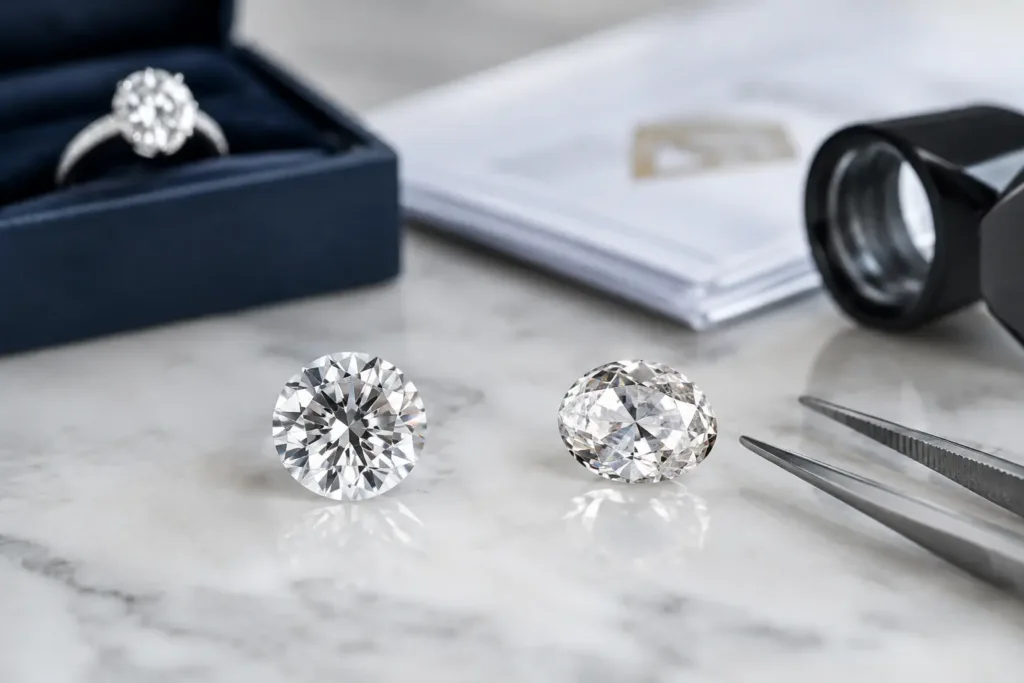
A diamond can look exceptional under a jeweller’s lights yet carry a very different price once its quality is independently assessed. That is why the choice between certified versus uncertified diamonds deserves more than a quick glance at carat weight or sparkle. For an engagement ring, a meaningful gift or a long-term jewellery purchase, certification gives you a clearer basis for judging what you are buying.
A diamond certificate is more accurately called a grading report. It is an independent document that records the characteristics of an individual loose diamond after examination by a gem laboratory. It is not a guarantee of future value, an insurance valuation or a statement that the diamond is ethically sourced. Its purpose is to identify and grade the stone using recognised criteria.
A typical report sets out the diamond’s carat weight, colour, clarity and cut grade, often referred to as the 4Cs. Depending on the laboratory and diamond shape, it may also include measurements, proportions, polish, symmetry, fluorescence, a plotted clarity diagram and comments on treatments or growth origin.
Many certified diamonds are laser-inscribed with the report number on the girdle. This tiny marking can be matched to the accompanying report, providing another useful layer of reassurance. A reputable retailer should be able to explain the report clearly and ensure that it corresponds with the diamond being offered.
The key difference is confidence in the information behind the price. With a certified diamond, the quality claims are supported by an independent third party. With an uncertified diamond, you are relying primarily on the seller’s description and expertise.
That does not mean every uncertified diamond is poor quality, nor that every certified diamond is automatically a wise purchase. A beautiful diamond can be sold without a report, particularly when it is small, part of an older piece or used alongside other stones in a jewellery design. Equally, a report cannot make a poorly cut diamond look more brilliant than it is.
However, where a diamond is a substantial part of the purchase price, certification makes comparison far more straightforward. Two stones may both be described as one carat, near-colourless and eye-clean, but their actual grades, proportions and visual performance can vary considerably. A report turns broad sales language into information you can check.
For buyers comparing diamonds remotely, including those arranging UK-wide or international delivery, that transparency becomes even more valuable. You should not have to make a high-value decision based on a photograph alone.
An engagement ring is often one of the most personal and significant jewellery purchases a couple will make. The diamond’s beauty matters, but so does being able to understand precisely what sits at the centre of the ring.
Certification gives you a consistent reference point when choosing between natural and lab-grown diamonds. Both can be graded for the same core characteristics, but they are different products with different market dynamics. A laboratory report should state whether the diamond is natural or laboratory-grown, so there is no ambiguity about origin.
It also helps when considering insurance, future valuations and any later repair or remodelling work. An insurer may ask for detailed diamond information, and a grading report can support the documentation held for the piece. It is sensible to keep the report, purchase receipt and valuation together in a safe place.
For bespoke rings, a certificate allows the conversation to be more precise. Rather than simply asking for a ‘sparkly’ diamond, you can discuss your preferred balance of size, colour, clarity and cut, then select a stone that suits the chosen setting and budget.
Carat weight is easy to notice, but cut is often the quality that has the greatest influence on brilliance and fire. A well-cut round brilliant diamond can appear lively and bright even when it is not the highest colour or clarity grade. Conversely, a larger stone with weak proportions may look less impressive than its carat weight suggests.
Reports are particularly useful here because they record proportions beyond the headline 4Cs. Still, paper grades do not replace expert selection. The diamond should be assessed for its overall appearance, including whether it faces up attractively, has pleasing light return and suits the setting you have chosen.
Not all grading reports carry the same weight in the trade. Laboratories such as GIA, IGI and HRD are widely recognised, although their reports may differ in format, grading approach and the types of diamonds they commonly assess.
GIA reports are often regarded as a benchmark for natural diamonds, particularly for buyers who want highly established grading standards. IGI is well known across both natural and laboratory-grown diamonds and is widely seen in modern diamond jewellery. HRD is another respected European laboratory with a long-standing presence in diamond grading.
The name of the laboratory matters, but so does reading the report in full. Check that the report number matches the stone, that its date and details are consistent with the item being sold, and that the listed shape, carat weight and grades align with the retailer’s description. If a report uses unfamiliar terminology, ask for it to be explained before proceeding.
Uncertified does not always mean unsuitable. In certain purchases, the additional cost and logistics of a report may not offer meaningful benefit. This can apply to very small accent diamonds, commonly called melee, where individual certification is impractical. It may also apply to vintage jewellery where the character, craftsmanship and condition of the complete piece matter more than a modern report for one stone.
An uncertified diamond may also appeal where your budget is tightly focused on the finished design rather than a standalone centre stone. For example, a pavé-set dress ring, a diamond pendant or a pair of earrings can still be made to a high standard with carefully selected diamonds that are not individually certificated.
The trade-off is that you have less independent evidence for the exact quality. This makes the retailer’s reputation, product description, return policy and aftercare especially important. Ask whether the stated colour and clarity are assessed ranges or specific grades, whether the diamond has been treated, and whether it is natural or lab-grown.
For a prominent centre diamond, particularly one of a meaningful carat weight, a certified option is usually the more transparent choice. The modest saving on an uncertified stone can be difficult to justify if it leaves you unable to compare like for like.
A certificate should support your decision, not make it for you. It does not assess the quality of the ring mounting, the security of the claws, the finish of the setting or whether the metal is appropriate for everyday wear. In the UK, precious-metal jewellery should also carry the relevant hallmark where required, offering separate reassurance about the metal itself.
Certification also does not replace a proper valuation. A grading report describes the diamond, while a valuation estimates replacement cost or market value for a specific purpose and at a particular point in time. These are different documents with different uses.
Ethical considerations require their own questions too. A grading report may identify the diamond as natural or laboratory-grown, but it is not automatically proof of responsible sourcing. Buyers who value provenance should ask their jeweller about sourcing policies and the steps taken to provide clear, responsible supply information.
Start with the diamond’s role in the piece. If it is the centre stone in an engagement ring or a significant solitaire pendant, prioritise an independently graded diamond from a recognised laboratory. Decide which qualities matter most to you before comparing options. Some buyers prefer to maximise size, while others will pay more for a higher colour grade or exceptional cut.
Then look beyond the report. Review clear imagery or view the diamond in person where possible. Consider how its shape works with the ring design, how securely it will be set and whether the metal complements its appearance. A warm yellow-gold setting, for instance, can be a beautiful choice and may allow greater flexibility on colour than a platinum solitaire.
Finally, buy from a jeweller that is prepared to discuss the details without pressure. At Hispek Diamonds, certified diamond options, bespoke guidance and practical support are designed to make a major purchase feel considered rather than complicated.
The best diamond is not simply the one with the strongest grades on paper. It is the stone whose beauty, documentation and price all make sense together, leaving you confident each time you look at it.
Compare certified versus uncertified diamonds with confidence. Learn what grading reports prove, when they matter, and how to buy with clarity today.

Understand the top reasons to buy gold bullion, from portfolio diversification and VAT efficiency to ownership, liquidity and confidence for UK buyers.

Use this bullion taxation guide to understand UK VAT, Capital Gains Tax and inheritance considerations when buying, selling or gifting investment gold.
Explore engagement ring upgrade examples, from larger centre stones to bespoke resets, with practical advice on value, comfort and diamond certification.

Use this bullion dealer comparison to assess pricing, product authenticity, delivery, storage and buy-back support before you invest in physical gold.
To layer 22K gold chains successfully, Hispek Diamonds plans the order before putting anything on. Different lengths create separation, compatible link structures reduce friction, and…