
Lab Diamond Demand Trends in 2025
Lab diamond demand trends in 2025 reflect shifting values on price, design and ethics, with buyers comparing certification, quality and resale.
We Buy Gold . Top Prices Paid .
7 Day Price Promise .
30 Day Returns
Free World Wide Shipping
Life Time Warranty
We Buy Gold . Top Prices Paid .
7 Day Price Promise .
30 Day Returns
Free World Wide Shipping
Life Time Warranty

+44 203 965 6669
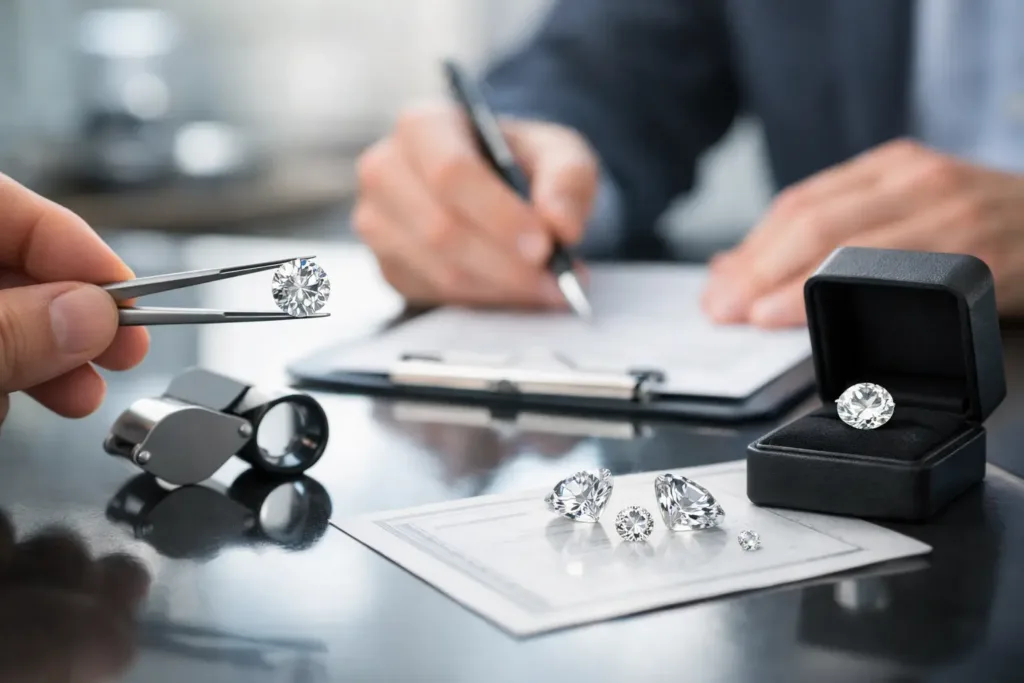
A diamond can look exceptional in a photograph and still be a poor buy. That is why diamond certification explained in plain English matters so much, especially when you are choosing an engagement ring, a gift with lasting value, or a diamond you expect to hold its appeal for years.
Certification gives you an independent assessment of what you are buying. It does not replace seeing the diamond, and it does not tell you whether a ring suits your style, but it does provide an objective benchmark. When you are spending serious money, that benchmark is not a luxury. It is part of buying properly.
In simple terms, diamond certification is a grading report issued by an independent gem laboratory. The report records the stone’s measurable characteristics, most notably the 4Cs – carat, cut, colour and clarity – along with other details such as polish, symmetry, fluorescence and proportions.
Many buyers call this a certificate, and that is common industry language, but in practice it is usually a grading report. The key point is independence. A trusted laboratory assesses the stone using recognised grading standards, rather than relying only on a retailer’s description.
This matters because two diamonds can appear similar at first glance while differing significantly in quality and price. Without a report, you are relying heavily on opinion. With a report, you have a clearer basis for comparison.
The biggest benefit is confidence. A certified diamond gives you a documented description of what you are paying for, which helps reduce uncertainty on a high-value purchase.
It also helps with price transparency. If a diamond is graded by a respected lab, you can compare it more fairly against other stones with similar specifications. That is particularly useful when shopping online, where trust signals matter even more.
Certification can also support future services. If you ever need insurance valuation, resale discussions, or simply want a record for your own files, a grading report is useful to have. For engagement rings and bespoke jewellery in particular, the paperwork becomes part of the item’s long-term ownership history.
That said, certification is not the whole story. A report cannot tell you everything about beauty. Two diamonds with the same broad grades can still look different because of cut precision, light performance and overall character. Certification is the foundation, not the full decision.
When people search for diamond certification explained, they are often really asking which laboratory names they should trust. This is an important question because grading standards are not identical across all labs.
GIA is widely regarded as one of the most recognised and consistent laboratories in the diamond trade. IGI is also well known, particularly in modern retail and often with lab-grown diamonds, though it is used for natural diamonds too. HRD is another established name seen in international markets.
The reason this matters is simple. A diamond graded by a strict, respected laboratory generally inspires greater confidence than one graded by an unknown or softer lab. If grading standards are loose, the stated quality may look better on paper than it truly is.
For buyers, the practical takeaway is straightforward. Look at who issued the report, not just the grades printed on it.
A proper grading report usually starts with the basics – shape and cutting style, measurements and carat weight. It then sets out the colour and clarity grades and, for round brilliant diamonds especially, often includes an overall cut grade.
You will usually also see polish and symmetry. These describe the quality of the diamond’s finish and how precisely its facets align. Fluorescence may also be listed, which refers to how the stone reacts under ultraviolet light. In some diamonds this makes little visible difference, while in others it can affect appearance or market value.
Many reports include a plotted clarity diagram showing the position of internal inclusions and external blemishes. This can be useful for identification as well as understanding the stone’s character.
Some diamonds are laser inscribed with the report number on the girdle. This is not visible in normal wear, but it can help match the stone to the paperwork.
The 4Cs remain the core of diamond grading, but they do not all carry equal visual importance.
Carat is the weight of the diamond, not its visible size alone. A well-cut diamond can look better balanced than a heavier stone with poor proportions.
Cut is often the most important factor for sparkle. It affects how light moves through the diamond and returns to the eye. A diamond with strong cut quality can appear brighter and more lively, even if its colour or clarity is not at the top of the scale.
Colour measures how colourless a white diamond is, usually on a scale from D to Z. Higher grades are rarer, but many buyers find excellent value in near-colourless stones that still look beautifully bright once set.
Clarity assesses internal inclusions and external blemishes. Higher clarity usually means fewer visible features, but many diamonds with modest clarity grades still appear clean to the naked eye. For most buyers, eye-clean appearance matters more than paying a premium for microscopic perfection.
This is where expert guidance becomes valuable. The best diamond is rarely the one with the highest grades across every category. It is the one that balances beauty, budget and purpose.
Certification is just as relevant for lab-grown diamonds as it is for natural diamonds. In both cases, the report confirms the key grading characteristics and identifies the stone correctly.
For lab-grown diamonds, the report should clearly state that the diamond is laboratory-grown. That distinction is essential for transparency and pricing. Lab-grown diamonds can offer impressive size and quality for the budget, while natural diamonds retain their own rarity and traditional appeal. Neither choice is automatically better – it depends on what matters most to you.
What should stay the same is your expectation of proper documentation. Whether you choose natural or lab-grown, certification helps you buy with clarity.
A grading report is powerful, but it has limits. It does not tell you whether the diamond is good value at the asking price. It does not tell you whether the setting is well made. It does not tell you how the finished ring will look on the hand.
It also does not capture every nuance of light performance. Two diamonds with similar certificates can still differ in brilliance, fire and scintillation. This is why videos, high-quality images and knowledgeable support remain important, particularly for online purchases.
There is also the matter of preference. Some buyers want the whitest possible diamond. Others prefer a larger carat weight and are happy to compromise slightly on colour or clarity. Certification informs that choice, but it cannot make it for you.
Start by checking the lab. Then compare the headline grades, but do not stop there. Look at measurements, proportions, cut information and any comments on the report.
If two diamonds are similarly priced, ask why. One may have stronger cut quality, a better colour grade, or simply come from a more respected lab. Equally, a lower-priced stone may represent excellent value if its differences are minor in real-world appearance.
It is also wise to think about the final piece of jewellery. In a solitaire engagement ring, the centre diamond has nowhere to hide, so cut quality and face-up appearance are especially important. In a halo or more detailed design, you may have a little more flexibility in how you balance the grades.
For many customers, the most sensible approach is to choose a certified diamond that looks beautiful without overpaying for specifications that are hard to appreciate in daily wear.
If you are investing in a diamond, certification should be considered standard rather than optional. It supports transparency, strengthens trust and gives you a reliable way to compare one stone with another.
At the same time, the smartest purchase is not made by certificate alone. It comes from combining independent grading with expert advice, clear imagery, honest pricing and a retailer that stands behind what it sells. That balance is where confidence really comes from.
A diamond is often bought for a milestone, not just a moment. The right certification helps ensure that what looks special today still feels like a sound choice years from now.
Lab diamond demand trends in 2025 reflect shifting values on price, design and ethics, with buyers comparing certification, quality and resale.
Learn how to buy 22k gold chains with confidence. Compare purity, weight, hallmarking, styles, pricing and fit before you choose.
Wedding jewellery trends 2026 favour personal design, mixed metals, bold pearls and certified diamonds with lasting value for modern couples.
Learn how to clean gold jewellery safely at home, protect stones and plating, and keep your pieces bright without causing avoidable damage.
Find diamond anniversary gifts that balance beauty, meaning and value, with expert tips on rings, pendants, earrings and bespoke options.
Our guide to diamond fluorescence explains what it is, how it affects appearance and value, and when it can be a benefit in your diamond choice.