

Can Gold Jewellery Be Resized? What to Know
Can gold jewellery be resized? Learn which rings, chains and bangles can be altered, what affects cost and fit, and when expert advice matters in the UK.
We Buy Gold . Top Prices Paid .
7 Day Price Promise .
30 Day Returns
Free World Wide Shipping
Life Time Warranty
We Buy Gold . Top Prices Paid .
7 Day Price Promise .
30 Day Returns
Free World Wide Shipping
Life Time Warranty

+44 203 965 6669
A ring that spins, a bracelet that catches on everything, or a chain that sits just below the neckline can change how often you wear a treasured piece. So, can gold jewellery be resized? In many cases, yes – but the safest method, the final result and even whether resizing is advisable depend on the design, gold purity and construction of the piece.
Fine gold jewellery is made to be enjoyed for years, not left in a box because the fit is slightly wrong. A professional assessment helps protect its appearance, structural strength and any diamonds or gemstones while giving you a more comfortable fit.
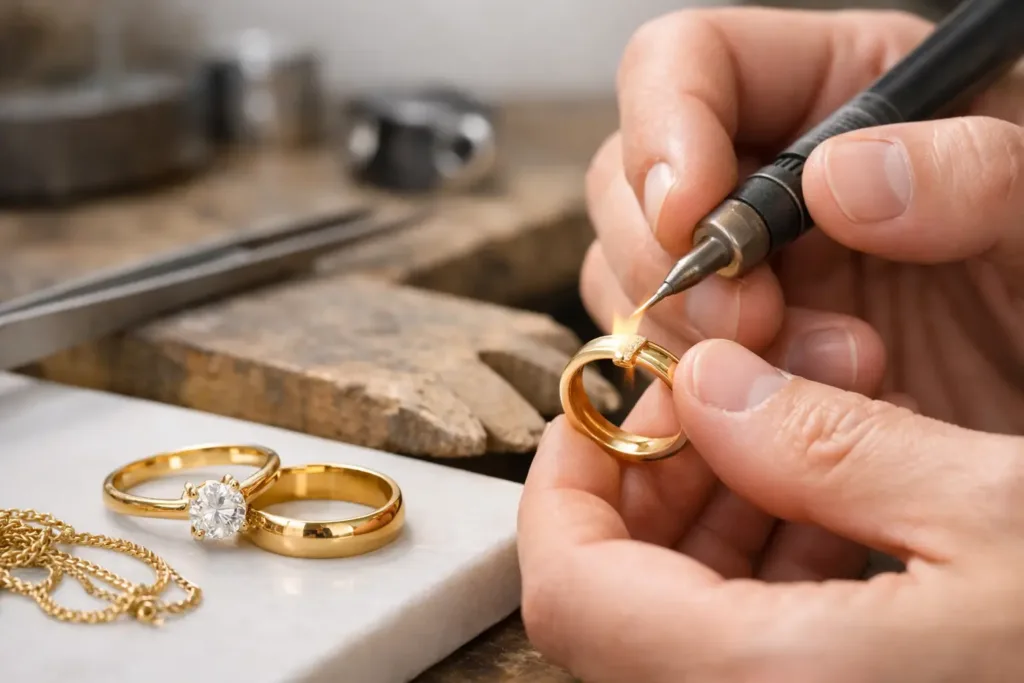
Most plain gold rings can be resized safely by an experienced jeweller. This is particularly true for classic wedding bands, solitaires and simple signet rings in 9K, 14K, 18K or 22K gold. The jeweller will normally reduce the size by removing a small section from the lower part of the shank, or increase it by adding matching gold. The ring is then carefully soldered, shaped, polished and checked.
The answer becomes less straightforward when a design has stones, intricate engraving, a patterned shank or mixed metals. A high-quality resize should be difficult to spot, but it cannot be treated as a one-size-fits-all repair. The piece needs to be examined before work begins.
Gold itself is relatively workable, which is why resizing is often possible. However, the alloy matters. Lower-karat gold contains a greater proportion of other metals, while 22K gold is softer and requires considered handling to retain its form and finish. A jeweller should match the metal colour and carat as closely as possible, especially for yellow, white and rose gold.
Rings are the most commonly resized type of gold jewellery. Plain bands are generally the simplest, while engagement rings can often be adjusted too, provided the setting allows it. A modest change of one or two sizes is usually more straightforward than a major alteration.
For a ring that is too large, removing a section of the band is often the cleanest approach. For a ring that is too small, a matching piece of gold can be added at the base of the shank. In some cases, small sizing beads inside the band offer a useful alternative for rings that only need a slightly tighter fit or need to accommodate larger knuckles.
Chains are not resized in the same way as rings, but many can be shortened. Removing links and reattaching the clasp can create a more flattering length, particularly with plain curb, belcher or trace chains. Some designs can also be lengthened with a matching extension section, although a perfect colour and link match is not always available.
The condition of the chain matters as much as the desired length. Very fine, hollow or worn links may not be suitable for alteration. A reputable jeweller will inspect the clasp, solder points and overall strength rather than simply cutting the chain to size.
Link bracelets can often be shortened by removing links, and occasionally lengthened if matching links are available. Rigid gold bangles are more complex. A plain bangle may allow a small adjustment, but opening or reshaping it can affect its circular profile, clasp mechanism or decorative finish.
Hinged bangles, stone-set bangles and hollow styles need particular care. For these pieces, replacing the item with a better-fitting design or commissioning a bespoke version may be a wiser long-term choice than forcing an alteration.
Earrings and pendants are rarely described as being resized, although their fittings can often be repaired or adapted. For example, an earring post may be replaced, a pendant bail may be enlarged to fit a preferred chain, or a drop can be shortened. These are specialist alterations, especially where gemstones, enamel or delicate detailing are involved.
Some gold jewellery should not be resized, or should only be altered after a detailed professional inspection. Eternity rings are a common example. If diamonds or gemstones run all the way around the band, changing the circumference can disturb stone spacing and place pressure on the settings. Depending on the design, a jeweller may be able to make a very minor adjustment, but an invisible result is not guaranteed.
Antique jewellery also deserves a cautious approach. Older pieces may have thinner shanks, historic hallmarks, fragile settings or previous repairs that limit what can safely be done. Altering an antique ring can affect its originality and value, even where the workmanship is excellent.
The same applies to rings with complex shoulders, tension-style settings, inlays, enamel, engraved messages or detailed patterns that continue around the entire band. Resizing may interrupt the design, make an inscription incomplete or create a visible difference in the finish.
Gold-plated jewellery is another consideration. It is not solid gold, and soldering, polishing or stretching can damage the plating. A repair may still be possible, but it should not be approached in the same way as a solid 9K, 18K or 22K gold piece.
Investment-grade 24K gold bars should never be altered. Their value is based on their stated weight, purity, recognised refinery and condition. Jewellery and bullion serve very different purposes, even though both are made from precious metal.
A proper resizing service begins with more than a finger measurement. The jeweller should assess the hallmark, metal type, thickness of the band, wear around the setting and condition of the claws. If diamonds or coloured gemstones are present, they should also consider whether heat or pressure could affect the stones.
White gold deserves an additional point of attention. After a resize, it may need rhodium plating to restore its bright white appearance and create a consistent finish across the ring. Rose gold can also vary noticeably between alloys, so matching the tone requires care.
For stone-set rings, the stones should be checked before and after the work. This is particularly valuable with engagement rings, where a loose claw can put a significant centre stone at risk. A professional clean and polish may be included or recommended, but excessive polishing should be avoided because it gradually removes a small amount of metal.
There is no universal limit, but small changes tend to deliver the best cosmetic and structural result. One or two sizes up or down is often manageable for a suitable ring. Larger changes may be possible with a plain, substantial band, yet they can alter the proportions of the design and put more strain on settings.
A ring that needs a substantial increase may look better remade to the correct size, particularly if it has a slim shank or elaborate diamond setting. This is where bespoke jewellery can provide better value over time: the proportions, metal weight and setting can all be designed for the wearer from the outset.
Finger size also changes more than many people expect. Warm weather, travel, pregnancy, exercise, medication and time of day can all affect how a ring feels. Before committing to a resize, try the ring at different times and consider whether the issue is permanent or seasonal. A correctly fitted ring should pass over the knuckle with gentle resistance, sit securely at the base of the finger and remain comfortable throughout the day.
Resizing costs vary according to the work required. A simple plain gold band is usually less complex than a diamond-set ring that needs stone checks, claw work, engraving restoration or rhodium plating. Adding gold, rebuilding a worn shank or matching a rare chain link will also affect the price.
Timing depends on the repair. Straightforward ring resizing may take a matter of days, while intricate pieces can require longer for careful bench work and final quality checks. If the jewellery is needed for a proposal, wedding or special occasion, allow enough time rather than relying on a last-minute alteration.
Choose a jeweller who is clear about the proposed method, the likely finish and any risks specific to your piece. For valuable jewellery, ask how it will be recorded, stored and insured while in their care. Hallmarks, certification and any previous valuation documents should be retained, particularly for high-value diamond jewellery.
At Hispek Diamonds, expert guidance can help you decide whether resizing, repair or a bespoke remake is the right route for a piece intended to be worn for a lifetime.
A well-fitted gold piece should feel effortless, but the work behind that result should never be rushed. Have your jewellery assessed by a skilled professional, choose the solution that respects its design, and you can wear it with the comfort and confidence it deserves.
Can gold jewellery be resized? Learn which rings, chains and bangles can be altered, what affects cost and fit, and when expert advice matters in the UK.
A Kolkata-style 22K gold ring is easier to understand when you stop looking at it simply as a yellow gold ring and start examining how…

Discover platinum jewellery benefits, including enduring strength, natural white colour, skin-friendly purity, rarity and considered long-term value.
Discover platinum jewellery benefits, including enduring strength, natural white colour, skin-friendly purity, rarity and considered long-term value.
When a 22K gold ring is sold by weight, the gram weight of the ring becomes an important part of understanding what you are buying…
Compare natural diamonds vs lab diamonds by beauty, value, origin and price. Choose a certified stone for your engagement ring with confidence today.