

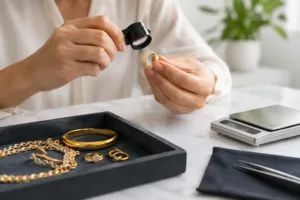
How to Value Gold Jewellery Before You Sell
Learn how to value gold jewellery with confidence, from hallmarks and carats to weight, live gold prices, gemstones and professional valuations in the UK.


You can physically wear a 22K gold ring while showering, swimming or exercising, but removing it first is generally the safer care routine. Higher karat gold contains a greater proportion of gold and is softer than lower karat gold alloys, which makes it more susceptible to scratches and dents. Swimming also introduces chlorine, salt water and the risk of the ring slipping from your finger, while exercise adds pressure, friction and impact.
At HiSpek Diamonds, our 22K gold ring collection includes pieces in different weights, sizes and designs, including detailed Kolkata style rings. Individual product pages can specify the metal, weight and available UK ring sizes, so how you care for a ring should take both its gold purity and its individual construction into account.
The main issue is not that brief contact with water automatically damages a 22K gold ring. The bigger concern is the combination of high karat gold, chemicals, residue, impact and loss risk.
GIA explains that higher karat gold is softer and therefore somewhat more vulnerable to scratches and dents. GIA also advises keeping fine jewellery away from chemicals because substances such as chlorine bleach can pit or damage gold alloys.
This makes removing the ring before certain activities a sensible preventive habit.
It is better to remove your 22K gold ring before showering.
Ordinary water is only part of what the ring encounters in a shower. Shampoo, conditioner, body wash, soap and other personal care products can leave residue on jewellery. Jewelers Mutual specifically advises removing rings for showering because these products can create buildup, while soaps can also make a ring easier to slip from the finger.
That matters particularly with rings containing:
The practical issue is therefore less about a few drops of water and more about repeated exposure to soaps and other products.
If putting the ring on after showering, it also makes sense to finish applying lotions, creams, perfume and other grooming products first. GIA notes that cosmetics and similar substances can contain chemicals that affect precious metals or delicate gems.
Removing the ring before entering a swimming pool or hot tub is the safer choice.
Chlorine is the main concern. GIA recommends removing fine jewellery before entering a chlorinated pool and notes that chlorine bleach can pit or damage gold alloys. Jewelers Mutual similarly warns that chlorine can damage or discolour metals including gold.
A pool also creates a second problem: loss.
Cold water can temporarily make your fingers smaller. That can loosen a ring that normally fits correctly, making it easier for it to slide off without you noticing.
For a valuable 22K gold ring, the combination of chemical exposure and accidental loss makes removal before swimming the more cautious option.
The same general recommendation applies to swimming in the sea: remove the ring first.
Salt water introduces another environment that is unnecessary for fine jewellery, but the larger practical risk can again be fit. Cold sea water can make your fingers contract temporarily, allowing a ring to become looser. Jewelers Mutual specifically warns about rings slipping off in cold pools, oceans, lakes and rivers.
That means even a ring that fits comfortably on land may not fit exactly the same way once you are in colder water.
Waves and movement make recovering a lost ring particularly difficult, so storage before entering the water is a much simpler precaution.
It is generally better to take your 22K gold ring off before exercising, particularly when the activity involves weights, machines, bars, rackets or other hard equipment.
Higher karat gold is softer than lower karat gold alloys, making avoiding unnecessary pressure and impact especially relevant.
Think about exercises such as:
In these situations, the ring can be pressed between your finger and a hard object. Jewelers Mutual specifically recommends removing rings for exercises involving equipment such as dumbbells, tennis rackets or golf clubs.
There is also a fit issue. Strenuous exercise can make your fingers swell temporarily, meaning a ring that was comfortable before the workout may become tighter afterwards.
For that reason, removing the ring before the workout is easier than trying to remove a tight ring once your fingers have already swollen.
Sweat alone is not the strongest reason to remove a solid 22K gold ring during exercise.
The more important considerations are usually impact, pressure, friction, hand swelling and contact with equipment.
This distinction matters because jewellery care advice should not treat every exposure as equally damaging. When lifting weights, for example, direct compression against a metal bar presents a more obvious mechanical concern than simply perspiring.
The safest habit is therefore to remove the ring before a workout rather than relying on how much you expect to sweat.
Yes. The individual construction of the ring should be considered alongside its gold purity.
HiSpek’s current 22K gold ring collection includes different ring bands, Kolkata style rings and other designs, and individual products can vary in weight and size. One Kolkata style product, for example, is listed in 22K gold with a specified gram weight and multiple UK ring size options. HiSpek also notes that weight can vary slightly with different ring sizes on that product.
This is why care should be based on the actual ring you own, rather than assuming that every 22K ring will respond identically to wear.
A plain band, an intricately patterned ring and a more elaborate design may present different surfaces and construction details. If you are uncertain about a specific piece, ask the jeweller about appropriate wear and care before exposing it to demanding activities.
Accidentally wearing a ring during one shower does not automatically mean the ring has been ruined.
The sensible response is to remove it, dry it carefully and inspect it for any visible change, residue, deformation or other problem.
If the ring has been exposed repeatedly to pool chemicals or appears damaged, professional inspection is preferable to experimenting with strong household cleaning products. GIA specifically cautions that chemical cleaners can be too harsh for jewellery and that chlorine bleach can damage gold alloys.
Avoid assuming that a stronger cleaner will solve the problem. Jewellery cleaning needs to suit the specific metal, construction and any stones present.
You do not need to remove a 22K gold ring for every ordinary moment of the day.
A practical approach is to remove it when an activity creates one or more of these conditions:
This approach protects the ring without making jewellery care unnecessarily complicated.
A 22K gold ring is designed to be worn, but sensible removal during higher risk activities can help reduce unnecessary exposure to scratching, denting, chemicals, residue and accidental loss.
For showering, removing the ring helps avoid soap and product buildup. For swimming, the stronger reasons are chlorine and loss risk. For exercise, pressure, impact and temporary finger swelling make taking the ring off before the workout the safer routine.
HiSpek Diamonds carries a range of 22K gold rings in different weights, designs and ring sizes, including Kolkata style and band designs. When choosing a ring, look beyond appearance alone and check the specifications of the individual piece so you understand exactly what you are buying.
Brief contact with ordinary water is not the main concern discussed in jewellery care guidance. Chemicals, soaps, chlorine, impact and accidental loss are stronger reasons for removing a ring before showering or swimming.
Chlorine exposure should be avoided. GIA states that chlorine bleach can pit or damage gold alloys and recommends removing fine jewellery before entering a chlorinated swimming pool.
Removing it is safer, especially for exercises involving weights, bars or other equipment. Higher karat gold is softer, while pressure from gym equipment can expose the ring to unnecessary mechanical stress.
Cold water can temporarily make your fingers contract. A normally secure ring can therefore fit more loosely and potentially slip off.
Generally, yes. GIA explains that higher karat gold contains more gold and is softer, while lower karat gold uses more alloying metals to increase strength.
Learn how to value gold jewellery with confidence, from hallmarks and carats to weight, live gold prices, gemstones and professional valuations in the UK.

A comfortable 22K gold bracelet fit should allow natural wrist movement without sliding so far that the bracelet catches easily or turns constantly. At Hispek…

Compare the best investment bullion products for UK buyers, from 24K gold bars to coins, with practical guidance on purity, premiums, VAT and storage.

To match a 22K gold pendant with the right chain, Hispek Diamonds looks beyond colour and style. The bail must accept the chain and its…

When you compare two 22K gold jewellery pieces of the same weight, one can look broad and substantial while the other appears compact and dense….
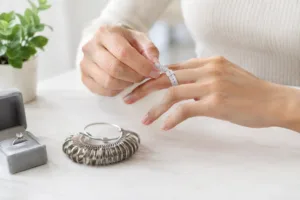
Ring size measurement made simple: learn how to measure at home, avoid common fit mistakes and choose a comfortable ring with confidence before buying.