

How to Match Wedding Bands With Your Ring
Learn how to match wedding bands with your engagement ring, from metals and profiles to settings, comfort, diamonds and a confident bespoke fit for life.
We Buy Gold . Top Prices Paid .
7 Day Price Promise .
30 Day Returns
Free World Wide Shipping
Life Time Warranty
We Buy Gold . Top Prices Paid .
7 Day Price Promise .
30 Day Returns
Free World Wide Shipping
Life Time Warranty

+44 203 965 6669
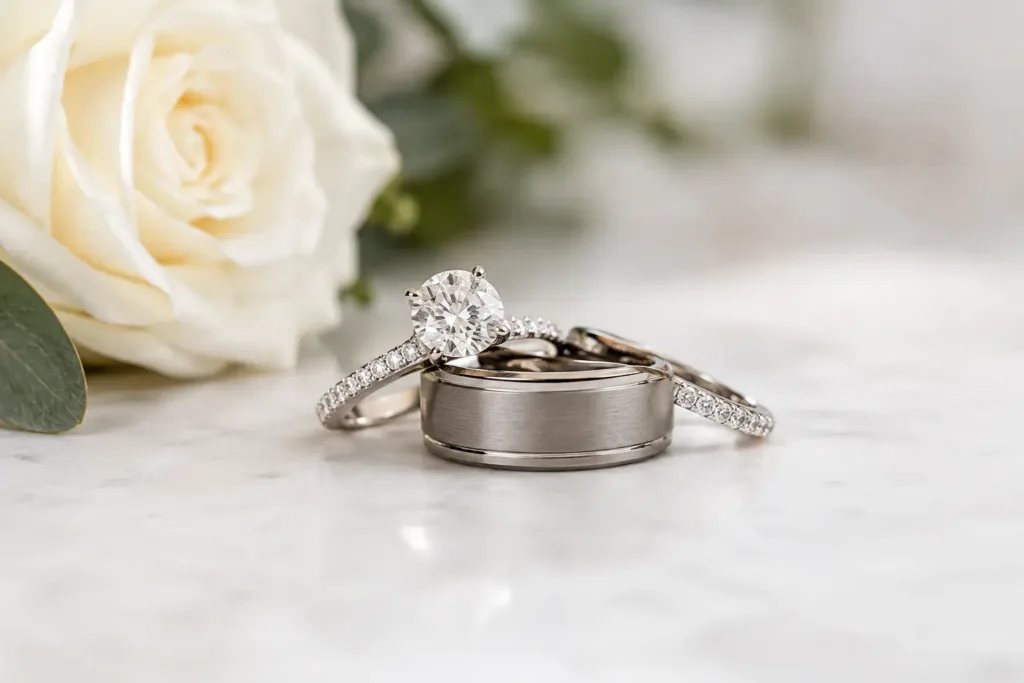
Your wedding band will sit beside your engagement ring every day, so the choice is about far more than selecting a beautiful ring on its own. Knowing how to match wedding bands means considering the fit, metal, proportions and setting together – then choosing a pairing that feels as good in years to come as it does on the wedding day.
There is no rule that says the two rings must be identical. Some of the most timeless bridal sets are perfectly matched; others use a subtle contrast in colour, texture or diamond detail. The right decision is the one that suits your engagement ring, your lifestyle and the way you want to wear your jewellery.
The profile of the engagement ring is the first practical detail to assess. A low-set centre stone, prominent gallery or wide shoulders can stop a straight wedding band from sitting flush against it. When rings are forced together, the result can be an uncomfortable gap, rubbing between the settings, or unnecessary pressure on the metal over time.
A straight band is often ideal for a solitaire with enough clearance beneath the centre stone. It creates a clean, classic line and allows the wedding ring to remain versatile if you ever choose to wear it alone. For a ring with a larger setting, a halo, side stones or a low basket, a shaped wedding band may be the more considered option.
A curved band has a gentle dip designed to follow the outline of the engagement ring. It works particularly well around round, oval, pear and marquise centre stones. A fitted, or contour, band is shaped more precisely around the engagement-ring setting and can give the appearance of a single, purpose-designed bridal set.
The trade-off is flexibility. A bespoke fitted band can achieve a close, polished fit, but its distinctive shape may look less balanced when worn alone. A slightly curved design often offers a useful middle ground: it accommodates the setting while retaining a recognisable wedding-band silhouette.
Before making a final choice, try the rings on together rather than judging from photographs. The view from above matters, but so does how the rings sit on the finger and whether they move comfortably when your hand is relaxed.
Matching metals remains the most traditional route, and for good reason. A platinum engagement ring paired with a platinum wedding band will develop a similar soft patina over time. Yellow gold alongside yellow gold delivers a warm, cohesive finish, while white gold creates a refined, bright look that complements both natural and lab-grown diamonds.
If your engagement ring is in 9K, 14K, 18K or 22K gold, matching the colour is usually more visually important than matching the exact carat. That said, hardness should be considered. A higher-carat gold band is richer in colour but generally softer, while platinum is dense and durable. The best combination depends on your daily routine, preferred finish and budget.
Mixed-metal bridal stacks can look equally intentional. A yellow gold engagement ring with a platinum setting, for example, can be paired with either a yellow gold band to emphasise warmth or a platinum band to echo the setting. The key is repetition: pick up one metal already present in the engagement ring so the contrast looks designed rather than accidental.
If you prefer a seamless appearance, take note of the band width as well as the metal. Two rings in the same yellow gold can still look disconnected if one is highly polished and narrow while the other is wide, heavily textured or matte.
Wedding bands are not just measured by width. Their depth, or how high they sit from the finger, also affects the finished look and feel. A very slim band next to a substantial engagement ring can appear delicate and elegant, but it may also look out of proportion or wear more quickly over decades of daily use.
As a guide, let the engagement ring lead. A fine solitaire often pairs beautifully with a 1.5mm to 2mm wedding band. A ring with broad shoulders, a wide shank or a statement centre stone can usually support a 2.5mm to 4mm band with more presence. These are starting points, not fixed rules. Finger size, hand shape and personal style matter just as much.
Profile is equally important. A court-shaped wedding band has a rounded exterior and interior, offering a traditional look and comfortable feel. A flat court profile appears more contemporary but retains a softened inner edge. Flat bands create clean lines, while bevelled styles introduce subtle definition.
Try to match the visual weight rather than every dimension exactly. A rounded engagement-ring shank beside a flat band can look modern and deliberate when their widths are balanced. Conversely, two bands with similar widths but very different depths may feel awkward as a stack.
A diamond-set wedding band can frame an engagement ring beautifully, especially when it repeats the same setting style. A pavé or micro-set band beside a diamond-set engagement ring creates continuous sparkle, while a plain precious-metal band lets the centre stone remain the focal point.
For maximum harmony, compare the diamond size, setting type and coverage. Small round diamonds in a shared-claw band may not sit naturally beside a ring with larger channel-set stones. A half-eternity ring is often a practical choice because the diamonds are visible across the top of the finger, while the plain underside makes future sizing more straightforward.
A full-eternity band offers uninterrupted brilliance but comes with considerations. It can be harder to resize, may feel less forgiving against another diamond-set ring, and requires careful setting quality to protect each stone. It is a premium, meaningful choice for those who want all-round sparkle, but not necessarily the most practical option for every lifestyle.
Do not assume a diamond wedding band must match the engagement-ring diamonds exactly. Natural and lab-grown diamonds can both offer exceptional beauty, provided the stones are well selected and the overall colour and clarity appearance are complementary. What the eye sees in normal wear matters more than a technical match on paper.
A wedding band is one of the few pieces of fine jewellery likely to be worn through work, travel, exercise and ordinary household routines. That makes comfort a priority, not an afterthought.
If you work with your hands, prefer minimal jewellery or are concerned about knocks, a plain court band or a low-profile diamond design may be the most sensible choice. If your engagement ring has a high setting, a shaped band should not make the stack sit even higher or catch unnecessarily on clothing.
Consider how the rings behave together. Do they spin independently? Is there a gap that collects soap or hand cream? Do any claws rub against the wedding band? A small spacer band can sometimes protect delicate settings, but it also changes the appearance of the stack and adds another ring to maintain.
It is also wise to confirm accurate sizing before ordering. The combined width of two rings can make a set feel tighter than an engagement ring worn by itself. Professional sizing and a careful fit check help avoid a band that is comfortable in the showroom but restrictive in warmer weather.
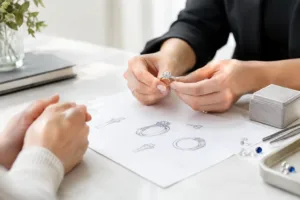
Some engagement rings simply need a more tailored solution. An unusual setting, a wide halo, an asymmetric design or a cherished heirloom ring may not suit a ready-made band. In these cases, a bespoke wedding band can be created around the exact shape and dimensions of the engagement ring.
A bespoke design does not have to be elaborate. It may be a refined contour in platinum, a yellow gold band with a carefully placed curve, or a diamond-set ring that follows the existing setting without overpowering it. The benefit is confidence that both rings have been considered as one composition.
At Hispek Diamonds, a custom approach can also make it easier to match metal colour, diamond character, finish and proportion while preserving the individuality of the original ring. For a significant purchase worn for a lifetime, that attention to detail is valuable.
Trends can offer useful inspiration, but your wedding band should not rely on a passing fashion to feel special. A clean plain band, a slim diamond eternity style and a carefully fitted contour have remained popular because they work with real life as well as formal occasions.
Take time to view the rings in daylight, from different angles and on your own hand. Ask to see polished and matte finishes if you are undecided, and consider whether you may add an anniversary or eternity ring later. Leaving a little visual room in the stack can make future additions feel natural rather than crowded.
The finest match is not always an exact match. It is the pairing that sits comfortably, protects the integrity of both rings and makes you want to look down at your hand long after the celebrations have passed.
Learn how to match wedding bands with your engagement ring, from metals and profiles to settings, comfort, diamonds and a confident bespoke fit for life.
Most people spend weeks choosing a diamond and a few minutes choosing the metal. That’s understandable, since the stone gets most of the attention. But…
Clarity is the grade that’s easiest to overthink. The scale runs from Flawless down to I3, and it’s tempting to assume you should climb as…

Are gold bars insured at home, in transit or in a vault? Learn what UK cover may include, the exclusions to check and how to protect bullion properly.
A bespoke jewellery design review explains how custom rings are made, what affects cost, and how to choose diamonds, metals and details with confidence.
Do lab diamonds hold value over time? Learn about resale, pricing, certification and choosing a lab-grown diamond with confidence in the UK before buying.