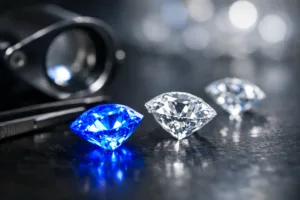
A Guide to Diamond Fluorescence
Our guide to diamond fluorescence explains what it is, how it affects appearance and value, and when it can be a benefit in your diamond choice.
We Buy Gold . Top Prices Paid .
7 Day Price Promise .
30 Day Returns
Free World Wide Shipping
Life Time Warranty
We Buy Gold . Top Prices Paid .
7 Day Price Promise .
30 Day Returns
Free World Wide Shipping
Life Time Warranty

+44 203 965 6669
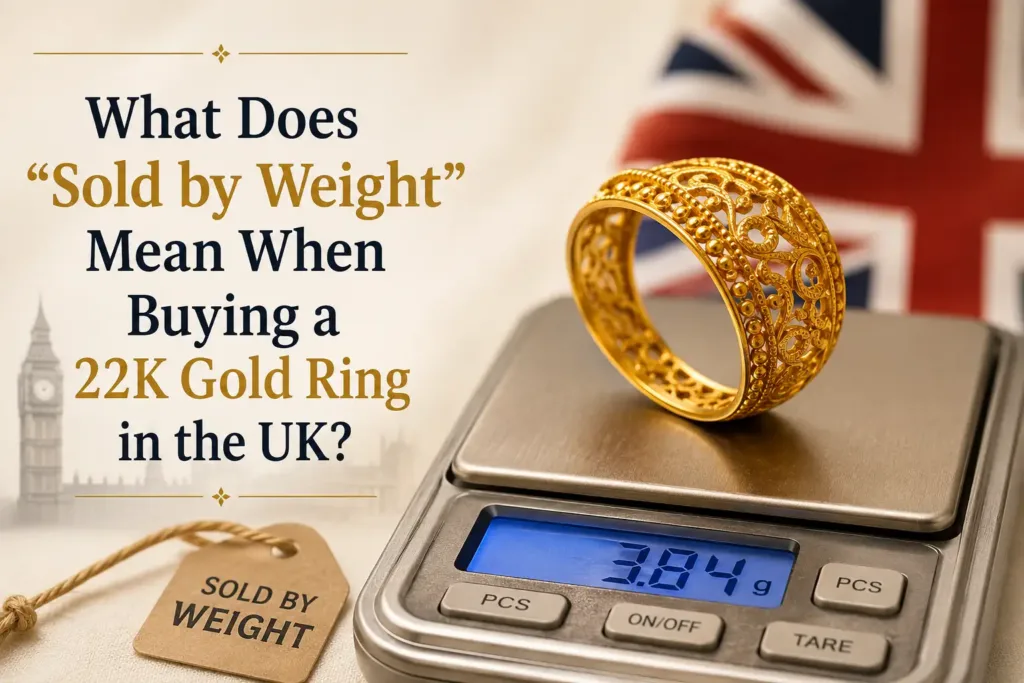
When a 22K gold ring is sold by weight, the gram weight of the ring becomes an important part of understanding what you are buying and why one ring may cost more than another. At Hispek Diamonds, our 22K gold ring collection lists individual pieces by weight, so you may see rings identified as 2.00g, 2.21g, 2.80g, 3.94g or another specific weight.
For a buyer, this creates a much clearer comparison than looking at design alone. Two rings can both be 22K gold, but if one contains considerably more gold by weight, you are not buying the same quantity of precious metal.
The important point is that sold by weight does not mean that design, manufacturing, hallmarking and other costs cease to matter. Weight tells you how much the ring weighs. It should be considered alongside purity, design, ring size and the complete selling price.
When a gold ring is sold by weight, its measured weight in grams is an important basis for the jewellery’s pricing and comparison.
Hispek’s 22K ring listings make this visible by placing the weight directly in many product names. For example, the collection includes rings listed at 2.00g, 2.02g, 2.14g, 2.21g, 2.80g and heavier weights.
That means you can compare two rings using more than photographs and style.
You can ask:
This makes the gram weight part of the purchasing decision rather than an invisible specification.
If two rings have the same 22K purity, the heavier ring contains a greater total quantity of the 22K gold alloy than the lighter ring.
For example, a 2.00g 22K ring and a 4.35g 22K ring are both sold as 22K gold within Hispek’s collection, but their total jewellery weights are substantially different.
This is why weight is useful when comparing rings.
A larger price on a heavier piece should not automatically be interpreted as meaning that its design is simply “more expensive.” Part of the difference can come from the greater quantity of gold contained in the piece.
Likewise, a lightweight ring is not necessarily inferior. You may prefer its proportions, appearance or style. The weight simply tells you something different about the physical amount of jewellery you are purchasing.
Hispek lists applicable 22K ring products with 916 gold purity. Its published gold guidance explains 22K as 22 parts gold out of 24, or approximately 91.6% gold.
This distinction is important when comparing jewellery by weight.
Five grams of jewellery sold as 22K should not be treated as equivalent to five grams of jewellery made at a different gold purity. The weight tells you the total mass, while the karat or fineness tells you the gold purity represented within that jewellery.
So when comparing gold rings, keep weight and purity together.
Do not compare gram weight while ignoring the karat.
Not necessarily.
“Sold by weight” should not be interpreted as meaning that a finished ring costs only the underlying raw gold value.
Hispek’s published guidance on custom gold jewellery says that pricing can depend on gold weight, current market rates and design complexity, and that custom quotations can include gold costs, manufacturing charges and hallmarking fees.
That distinction matters because you are buying finished jewellery, not an unworked quantity of gold.
A ring has a design, size and finished form. Depending on the product or custom order, factors beyond the underlying metal may therefore form part of the complete price.
For a standard product, use the actual product price shown for the piece rather than trying to calculate a purchase price from the gold market price alone.
The easiest answer is that they may simply contain different amounts of material.
Hispek’s current 22K ring collection includes lightweight and heavier pieces across different ring and Kolkata style designs. Individual products also differ in dimensions and form.
When comparing two pieces, look at the complete specification rather than expecting all 22K rings to weigh approximately the same.
Consider:
This is especially useful online, where photographs alone can make it difficult to judge how much gold is actually present in a piece.
Yes, the weight can vary slightly between sizes.
Hispek states on individual 22K ring product pages that weights may vary very slightly with different ring sizes. The products are also offered across multiple UK ring sizes.
This makes sense as a buying consideration because the weight shown on the page represents the specified product, while a different size may not be physically identical in weight.
If the precise gram weight matters to your purchase, confirm the weight associated with your selected size rather than assuming every available size has exactly the same mass.
Weight tells you how heavy the ring is. It does not, by itself, tell you the purity of the metal.
That is why purity and hallmarking belong in the same buying decision.
Hispek states that its 22K gold products above 1g are hallmarked at the Birmingham Assay Office in accordance with prevailing UK laws and standards. Individual 22K ring listings also identify the metal as 22K gold and, where specified, show 916 purity.
For the buyer, these pieces of information answer different questions:
Do not use one as a substitute for the others.
No. Weight is a purchasing attribute, not an instruction to buy the heaviest piece available.
A heavier ring gives you more total jewellery weight, but your decision can still depend on the design, size, intended use and budget.
For example, Hispek currently lists 22K rings across a range of weights rather than offering one standard gram weight for every design.
A buyer who wants a lighter, more understated ring can therefore make a different choice from someone specifically looking for a heavier piece.
The useful comparison is not:
heavier = automatically better
It is:
How much does this ring weigh, what purity am I buying, what design am I getting, and what is the complete price?
That gives you a more meaningful way to compare 22K rings.
Start with the actual product information.
Check the gram weight first, then confirm that the piece is identified as 22K gold. Where purity information is displayed, check the fineness information too.
Next, look at your UK ring size. If the product is available in several sizes and precise weight matters to you, remember that Hispek notes that weight can vary slightly between ring sizes.
Finally, look at the complete product price rather than attempting to value the finished ring using gram weight alone.
A practical buying check is:
At Hispek Diamonds, our 22K gold ring collection lets you compare individual pieces by design and gram weight, including Kolkata style, band and other ring options. If you want to compare different weights or need help with a particular size, explore our 22K gold rings or contact us about the specific piece you are considering.
FAQs
Hispek’s 22K gold ring collection is explicitly described as sold by weight, and individual products display their weight in grams. Buyers should still consider the complete product price, purity, design and hallmarking rather than treating a finished ring as raw gold alone.
Weight is an important pricing factor because a heavier ring contains a greater total quantity of the same 22K gold alloy. Hispek’s current ring collection shows different weights and prices across its 22K ring range. Other pricing factors can also apply depending on the product or custom order.
Hispek identifies applicable 22K jewellery as 916 gold purity, while its published guidance explains 22K as approximately 91.6% gold.
Yes. Hispek states that the weight of individual 22K rings may vary very slightly with different ring sizes. If exact weight is important, confirm it for the size you intend to purchase.
Hispek states that its 22K gold products above 1g are hallmarked at the Birmingham Assay Office in accordance with prevailing UK laws and standards.
Our guide to diamond fluorescence explains what it is, how it affects appearance and value, and when it can be a benefit in your diamond choice.

Compare the best diamond wedding band styles for every ring and budget, from eternity to pavé, with expert advice on fit, metal and value.
Learn how to choose lab diamond jewellery with confidence. Compare cut, certification, metal, style and value for a smart, lasting purchase.
Lab grown engagement ring trends for 2026 reveal shifts in cuts, settings and buyer priorities, from larger stones to bespoke, ethical design.
Choose gold jewellery with confidence. Learn about purity, hallmarking, style, value and care before you buy for gifting, weddings or wear.
Use our diamond carat size guide to compare popular weights, understand face-up size, and choose a certified diamond with confidence.